
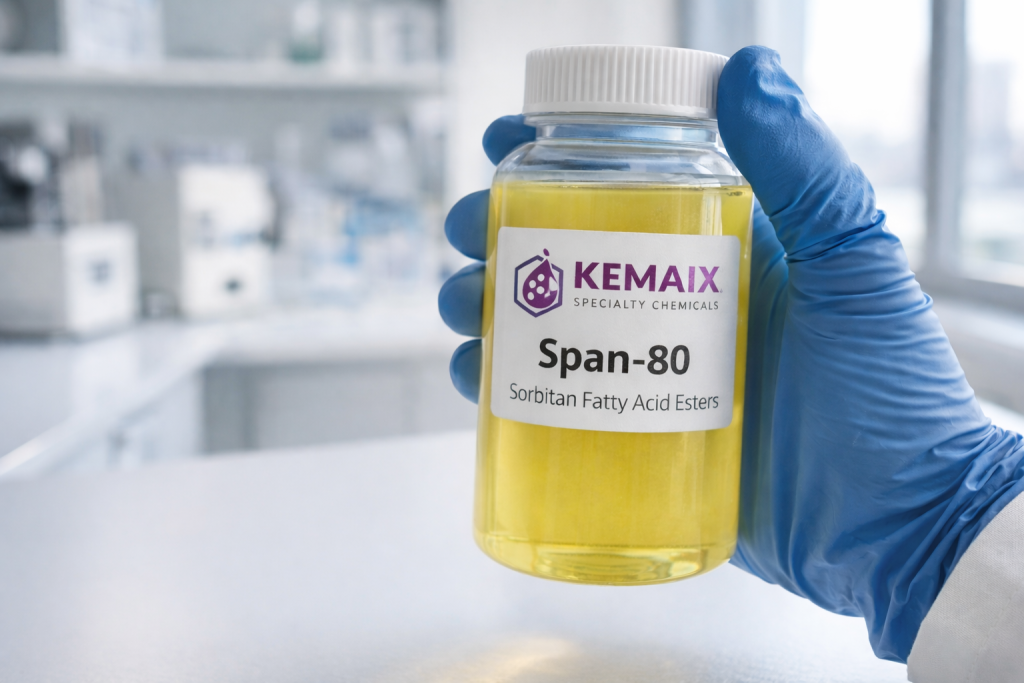
Span 80 Uses, HLB and Industrial Emulsifier Selection

Sorbitan Fatty Acid Esters-Span 80

Span 80 (sorbitan oleate) is a low-HLB nonionic emulsifier commonly screened for oil-rich and water-in-oil systems. Suitability depends on the oil phase, required HLB, co-emulsifiers, temperature and finished-emulsion stability tests.

Why Choose Kemaix Span 80 for Industrial Applications?

The Span 80 industrial benefits stem from its unique chemical stability and oil solubility. Use the current specification and batch COA to review the following screening properties:

  • Low HLB Value (4.3): A common starting candidate for oils, fats and solvents in water-in-oil screening.
  • Specification Controls: Acid value and moisture limits are grade- and batch-specific; confirm them on the current specification and COA, then test the complete pesticide or lubricant formulation.
  • Environmental Data Review: Feedstock origin does not by itself establish biodegradability, environmental compliance or a green-chemistry claim. Review current test data and the rules for the intended market and use.

The Synergy: Pairing Span 80 with Tween 80

To maximize Span 80 industrial benefits, formulators often use it in combination with its hydrophilic counterpart, Tween 80. By adjusting the ratio of these two surfactants, you can achieve any desired HLB value between 4.3 and 15.0.

This “surfactant pairing” is the industrial standard for creating highly stable O/W emulsions in agrochemical EC (Emulsifiable Concentrate) formulations and high-end cosmetic creams, where Span 80 acts as the oil-phase stabilizer while Tween 80 ensures water-phase dispersion.

Supplier Starting Ranges for Span 80 Screening

To fully leverage the Span 80 industrial benefits, precise dosage control is vital. The following supplier ranges are laboratory screening points, not validated use levels. Confirm compatibility, performance, safety and regulatory suitability in the finished formulation:

Industry Application Supplier Starting Range (%) Primary Function
Agrochemical EC 3% – 8% Emulsification of active ingredients
Metalworking Fluids 2% – 5% Lubrication & Rust inhibition
Textile Auxiliaries 1% – 3% Softening & Anti-static base
Industrial Cleaning 0.5% – 2% Solubilization of organic grease

Note: Kemaix suggests performing a compatibility test for each specific oil phase to determine the optimal surfactant ratio.

Technical FAQ

Q: What is the HLB value of Span 80 and why is it important?

A: Span 80 has an HLB value of approximately 4.3. This low value makes it an ideal primary emulsifier for Water-in-Oil (W/O) systems. It is also frequently paired with high HLB surfactants like Tween 80 to create stable O/W systems through precise HLB adjustment.

A: In explosives, Span 80 acts as a critical stabilizer that prevents the crystallization of oxidizer salts. Its thermal resilience ensures the explosive remains stable and safe during long-term storage and high-temperature transport.

A: Do not infer biodegradability or environmental compliance from feedstock origin alone. Review the exact grade identity, current biodegradation and aquatic data, intended use, concentration and applicable local requirements.

A: It forms a robust interfacial film between the metal surface and the cutting oil, providing superior lubricity and rust protection while ensuring the fluid remains stable throughout repeated circulation cycles.

Leverage Span 80 Industrial Benefits Today

Whether you are formulating industrial lubricants or agricultural adjuvants, Kemaix provides high-purity Span 80 and expert technical guidance for your R&D projects.

Get Span 80 Samples & Pricing

Quick answer: where Span 80 fits in an industrial emulsion

Span 80 (sorbitan monooleate) is a lipophilic nonionic emulsifier commonly screened for water-in-oil systems, co-emulsifier blends and interfacial modification. Its usefulness depends on oil phase, required emulsion type, temperature, water fraction, shear and the other surfactants present. A published identity or food-additive specification does not make an industrial grade suitable for food, pharmaceutical or cosmetic use.

Formulation objectiveSpan 80 screening roleWhat must be confirmed
Water-in-oil emulsionLipophilic primary or supporting emulsifierDroplet size, separation, temperature cycling and water loading
O/W blend adjustmentLow-HLB component paired with a more hydrophilic surfactantBlend ratio, interfacial tension and aging
Process lubrication or releaseInterfacial modification and oil-phase compatibilityResidue, substrate effect and process compatibility
Regulated end useOnly a chemistry starting pointCorrect grade, specification, impurities, documentation and local authorization

Evidence boundary: supplier grade, purity and intended-use documentation control suitability. Do not transfer food-additive, cosmetic or pharmaceutical conclusions to an industrial material without grade-specific evidence.

Frequently asked Span 80 questions

Is Span 80 always the best emulsifier for a water-in-oil system?

No. It is a common lipophilic starting candidate, but the oil phase, water loading, temperature, shear and required stability determine the final emulsifier package.

Can Span 80 be blended with a hydrophilic surfactant?

Yes. Blending can adjust overall interfacial behavior, but the ratio must be validated by emulsion stability and application testing rather than HLB arithmetic alone.

Does a food-additive specification make every Span 80 grade food grade?

No. Suitability depends on the supplied grade, specification, impurities, manufacturing controls, documentation and authorization for the intended market and use.

Technical review: Grace Dou, emulsifier applications team. Reviewed 14 August 2026.

Primary references

Use the Span/Tween blend guide for ratio screening and the HLB guide for method boundaries.

Picture of Grace Dou

Grace Dou

Technical Content Reviewer. Grace Dou is a technical content reviewer at Nanjing Kemaix Advanced Materials Co., Ltd., focusing on EO/PO derivatives, nonionic surfactants, formulation scope, test conditions and documentation boundaries. Final grade selection should use current specifications and finished-formula testing.

Scroll to Top