
The Science of HLB: How to Select and Optimize Surfactants for Perfect Emulsions

Selection and Optimization of Surfactant HLB Value for Industrial Emulsions

Introduction: The Foundation of Emulsion Stability

Selecting the right emulsifier is the most critical step in formulating a high-performance oil-water system. While experimental screening remains the most reliable method, the Surfactant HLB Value (Hydrophilic-Lipophilic Balance) serves as the essential compass for this process. By understanding the HLB requirements of your oil phase and matching them with the right surfactant blend, formulators can achieve superior stability, texture, and efficiency.

I. Matching HLB Value to Your Emulsion Type

Every oil-water system has an “optimal HLB” requirement. Matching the HLB of your surfactant to the requirements of the oil phase ensures the lowest interfacial tension and maximum longevity.

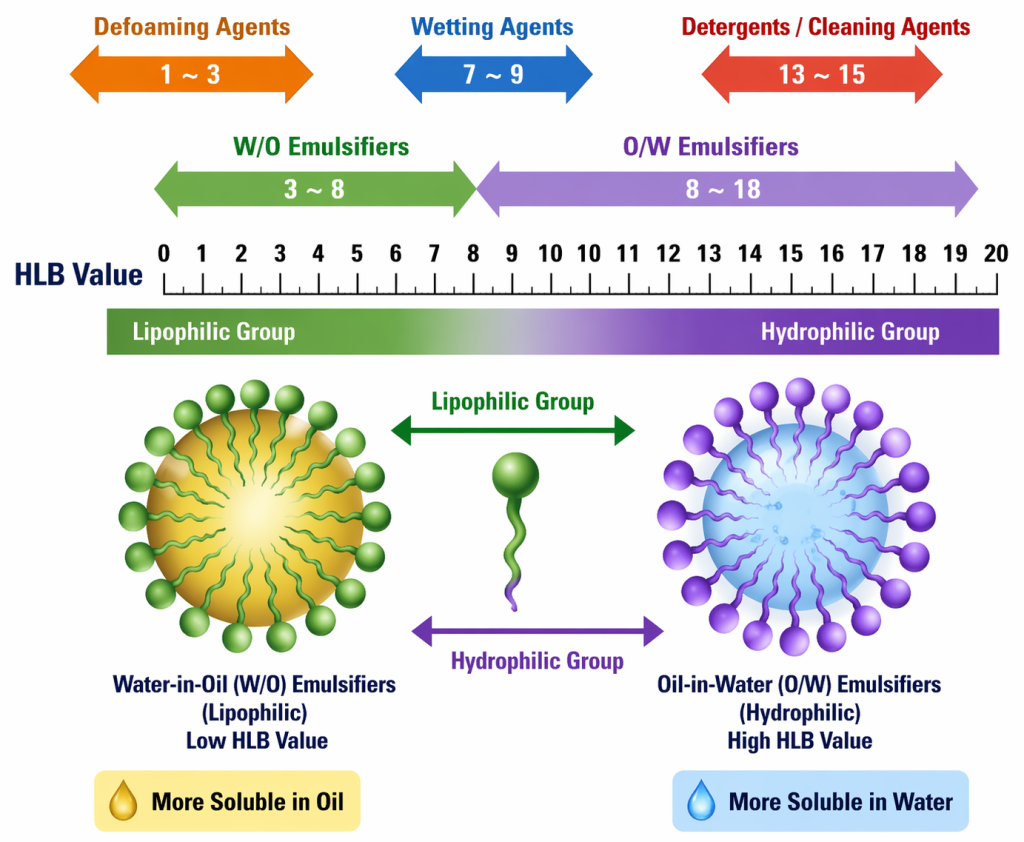
  • O/W (Oil-in-Water) Emulsions: Typically require emulsifiers with an HLB between 8 and 18. These surfactants are more water-soluble and facilitate the dispersion of oil droplets in a continuous water phase.

  • W/O (Water-in-Oil) Emulsions: These systems generally require a lower HLB range, typically between 3 and 6. These lipophilic surfactants stabilize water droplets within a continuous oil phase.

A simple, practical method to estimate the required HLB of an unknown oil is the “Spreading Test.” By observing how oil droplets spread on the surface of surfactant solutions with different HLB values, formulators can approximate the required value when the oil just fails to spread.

II. The Power of Blended Emulsifiers

Rarely can a single surfactant meet the complex demands of a multi-component industrial system. Blended emulsifiers (mixing surfactants with high and low HLB values) often yield better results than single agents due to their additive properties.

How to determine the optimal blend:

  1. Select two surfactants with significantly different HLB values (e.g., Span-60 at 4.7 and Tween-80 at 15).

  2. Prepare a series of blends at varying ratios to create a range of HLB values.

  3. Test the stability and efficiency of each blend.

  4. Plot a curve to find the “peak” stability—the HLB value at this peak is the required HLB for that specific system.

III. Advanced Optimization: Microemulsions and Interfacial Tension

When standard emulsions aren’t enough, microemulsions offer thermodynamic stability and transparency. Achieving this state requires precise adjustment of the Surfactant HLB Value and the addition of co-surfactants.

  • Reducing Interfacial Tension: Beyond the Critical Micelle Concentration (CMC), interfacial tension often plateaus. Adding co-surfactants (like C4–C7 medium-chain alcohols) can further lower interfacial tension below $10^{-5}$ N/cm, enabling the spontaneous formation of microemulsions.

  • Increasing Film Fluidity: Co-surfactants insert themselves into the surfactant monolayer at the oil-water interface. This reduces the rigidity of the interfacial film, allowing for the necessary curvature and deformation required for stable droplet formation.

Technical FAQ: HLB Calculation and Coordination

Q: How do I calculate the HLB of a surfactant blend?

A: The HLB of a mixture is a weighted average based on the mass fraction of each component. For example, if you use a 63% blend of Span-65 (HLB 2.1) and 37% SDS (HLB 40), the resulting HLB would be:

 (0.63 *2.1) + (0.37 * 40) ≈16.0

A: Unlike ionic surfactants, the Surfactant HLB Value of nonionic ethoxylates changes with temperature. As temperature increases, the hydrogen bonds between the water and the hydrophilic chain weaken, making the surfactant more lipophilic (effectively lowering its HLB). This is a vital consideration for products intended for variable climates.

Precision Engineering: Your Source for High-Performance Emulsifiers

As a leading manufacturer of industrial surfactants, KEMAIX understands that the right Surfactant HLB Value is the difference between a failed batch and a market-leading product. We provide high-purity surfactants and technical expertise to help you navigate complex HLB coordination.

Our Manufacturing Commitment:

  • HLB Precision: Our surfactants are rigorously tested to ensure batch-to-batch consistency in HLB performance.
  • Formulation Support: We assist in calculating the required HLB for complex oil phases, including fuels, lubricants, and cosmetics.
  • Cost-Effective Solutions: Optimized surfactant blends that achieve maximum stability at the lowest required concentration.
Picture of Grace Dou

Grace Dou

Specialist in EO/PO Derivatives & Surface Chemistry. With 10+ years of experience in chemical export and formulation optimization at Kemaix, Grace provides technical insights to help global clients achieve superior emulsification stability.

Need Free Samples for Testing?

Get professional technical support and free samples for your chemical formulations.

Get Samples Now
Scroll to Top