
Which AEO Grade Should You Choose?
Definition: AEO grades are nonionic fatty-alcohol ethoxylates whose average ethylene-oxide (EO) number controls water affinity, physical form and cloud-point behaviour. Use the EO number to shortlist a grade, then confirm cloud point, solubility and performance in the complete formulation.
| Selection need | Starting grade group | Why it fits | Validate before scale-up |
|---|---|---|---|
| Oil-soluble emulsification or AES feedstock | AEO-3 to AEO-5 | Lower EO content gives greater oil affinity | Required HLB, oil phase and conversion specification |
| Wetting, detergency or textile scouring | AEO-7 to AEO-9 | Higher water compatibility and useful aqueous cloud-point range | Temperature, electrolyte level, hardness and foam |
| High-EO emulsification or solid-form applications | AEO-15 to AEO-23 | Higher EO content increases hydrophilicity and changes physical form | Dissolution method, cloud-point test medium and final viscosity |
Data basis and limits: Grade groupings and typical ranges are derived from the current Kemaix series specification reviewed 13 August 2026; they are not batch-release limits. Confirm the grade-specific TDS, SDS and COA. Cloud point depends on the stated method and test medium; ISO 1065:1991 describes methods for ethoxylated nonionic surfactants. Regulatory identity must be checked against the exact alcohol chain distribution and EO range; the ECHA Alcohol Ethoxylate substance record illustrates why a family name alone is insufficient.
Evidence note: Capacity is a Kemaix company-reported operating metric, reviewed 13 August 2026. APEO-free status and other grade-specific claims must be confirmed from the current specification or declaration. Sample availability and standard lead time are service targets and must be confirmed in the written quotation.
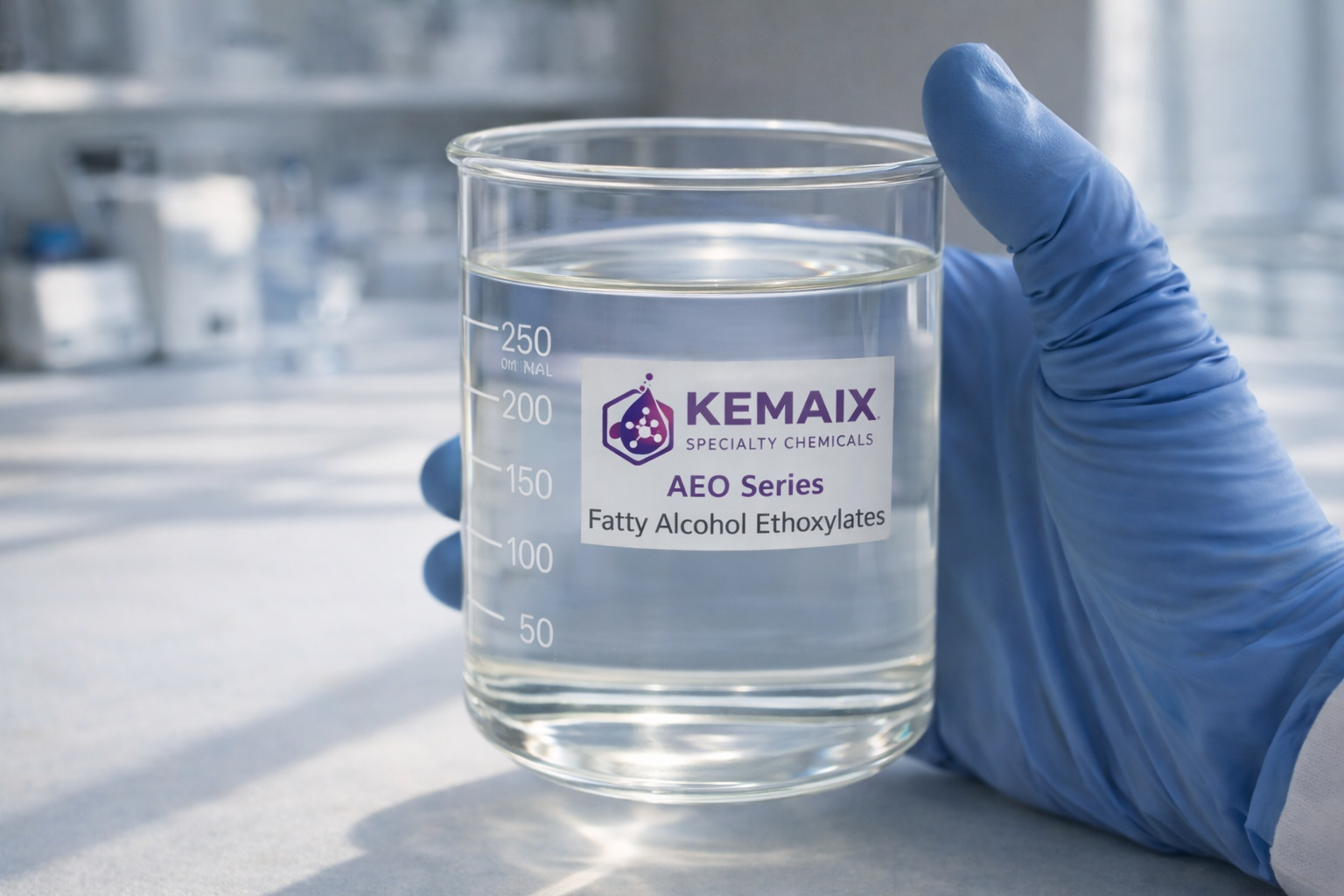
One Chemistry, Eight Grades, Two Completely Different Jobs
AEO is made by condensing C12–C14 fatty alcohol with ethylene oxide. The number of EO moles decides everything that follows — solubility, cloud point, and whether the grade emulsifies oil into water or water into oil.
Low-EO grades (AEO-3 to AEO-5) are oil-soluble W/O emulsifiers and AES feedstock. High-EO grades (AEO-7 and above) are water-soluble workhorses for detergency, wetting and scouring. Picking the wrong end of the range is the most common formulation mistake we see.
- CAS Number68439-50-9
- INCI NameLaureth-3 / Laureth-7 / Laureth-9
- Ionic TypeNonionic
- GradesAEO-3, 4, 5, 7, 9, 15, 20, 23
- DocumentationRequest the grade-specific APEO-free declaration and regulatory identity
AEO Series Technical Specifications
| Grade | Appearance (25°C) | Color (Pt-Co) | Cloud Point (°C, 1% aq.) | Hydroxyl Value (mgKOH/g) |
|---|---|---|---|---|
| AEO-3 | Colorless transparent liquid | ≤ 20 | — | 170–180 |
| AEO-4 | Colorless transparent liquid | ≤ 20 | — | 150–160 |
| AEO-5 | Colorless transparent liquid | ≤ 20 | — | 130–140 |
| AEO-7 | Colorless transparent liquid | ≤ 20 | 50–60 | — |
| AEO-9 | Milky white paste | ≤ 20 | 75–85 | — |
| AEO-15 | Milky white paste | ≤ 20 | 80–88* | — |
| AEO-20 | Milky white solid | ≤ 20 | 89–93* | — |
| AEO-23 | Milky white solid | ≤ 20 | > 100 | — |
*Cloud point measured under standard conditions. Custom EO mole, carbon-chain, cloud-point and HLB projects require application and production-feasibility review.
Grade-selection guide: Compare AEO-7 and AEO-9 by HLB, cloud point and industrial-cleaning performance.
Where Each Grade Group Belongs
AEO-3 / 4 / 5
Oil-soluble with good emulsifying performance. Used in W/O emulsification, textile auxiliaries, silicone and hydrocarbon emulsions, and as raw material for AES production.
AEO-7 / 9
Candidate grades for wetting, detergency, textile scouring and agrochemical-formulation screening. Validate cloud point, electrolyte tolerance, hardness and foam in the complete formulation.
AEO-15 / 20 / 23
Candidate grades for high-HLB emulsification, detergency and solubilising. Confirm dissolution procedure, process temperature, test medium and finished-formulation performance.
NP-10 / NPE replacement screening
Fatty-alcohol ethoxylates are common candidates when replacing alkylphenol ethoxylates. Confirm the grade-specific APEO-free declaration, then compare HLB, cloud point, wetting, detergency and formulation compatibility.
Selection & Handling Notes
⚠ Match cloud point to process temperature
Detergency and wetting peak at or just below the cloud point. Running well above it drops solubility — useful for low-foam behaviour, damaging if you needed the surfactant in solution.
⚠ EO number changes the job entirely
AEO-3 and AEO-9 are the same chemistry but behave oppositely. Confirm the EO mole number, not just the product family, when specifying.
⚠ Electrolytes lower cloud point
Salts and builders in a full formulation depress cloud point. Test in your actual formula, not in water.
⚠ Check hard-water tolerance
Nonionics tolerate hardness better than anionics, but verify at your dilution water hardness before scale-up.
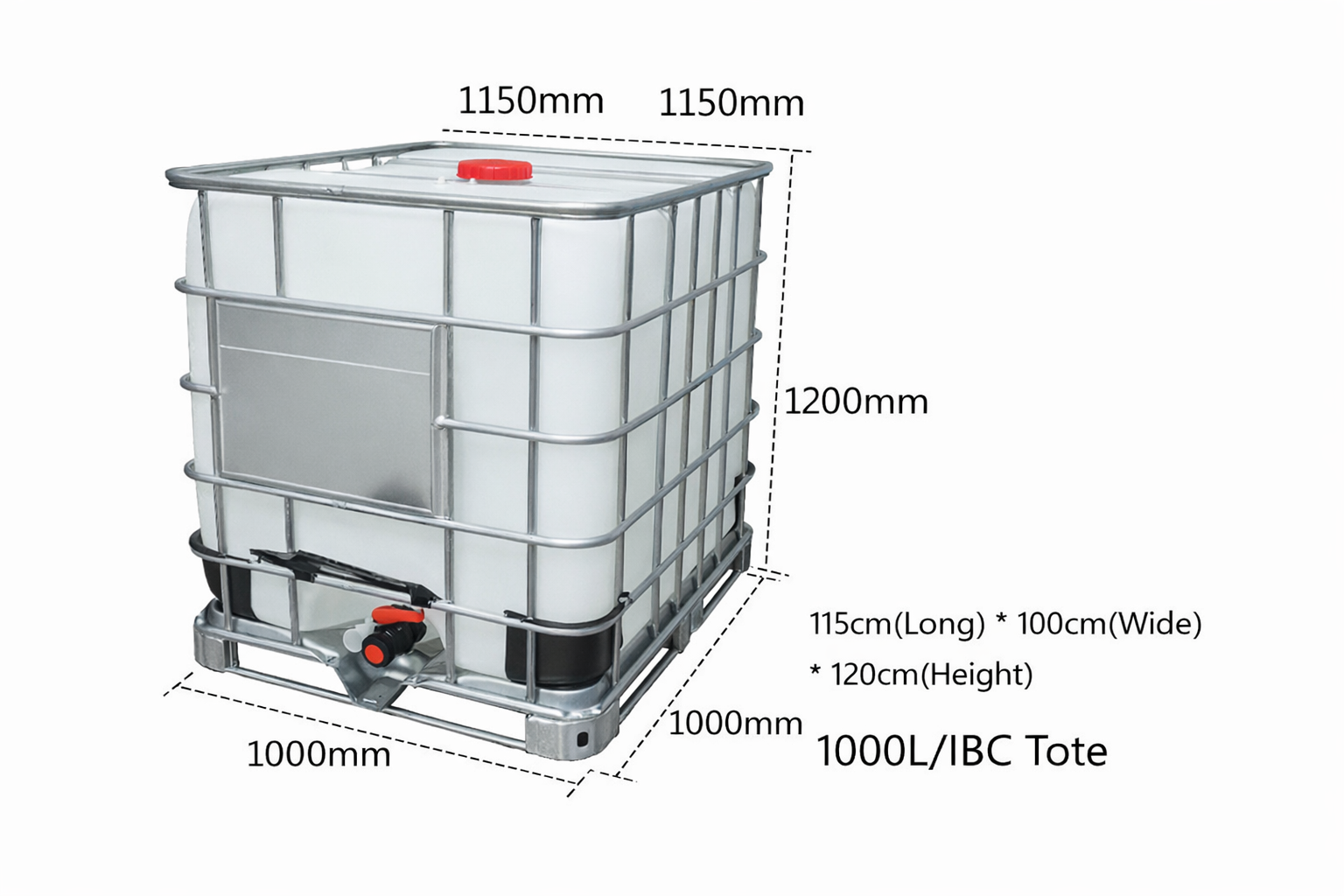
Packaging, Storage & Shipping
Packaging: 200 kg drums, 1000 kg IBC tanks and bulk. Non-hazardous and suitable for general transportation.
Storage: Cool, dry and well-ventilated conditions with containers kept closed. Shelf life 2 years from date of manufacture.
Shipping: FOB, CIF and CFR as FCL or LCL via Shanghai Port, with TDS, SDS and COA available for customs and customer regulatory review. Confirm REACH registration, Only Representative coverage and intended-use applicability for the specific grade and destination market.
AEO and Formulation Guides
Alcohol Ethoxylate Selection Guide
Choose alcohol ethoxylates by EO number, HLB, cloud point and process conditions.
Gentle Surfactants for Personal Care
Compare sulfate-free surfactant options for mild cleansing, foam quality and formulation compatibility.
End-Capped Alcohol Ethoxylates
Understand how end capping changes gel formation, foam and concentrated-formula handling.
Isomeric Alcohol Ethoxylates
Compare AEO candidates for industrial wetting and cleaning, then verify grade-specific APEO-free status from current documentation.
Choosing Surfactants for Detergents
Match nonionic, anionic and amphoteric surfactants to detergency, foam and compatibility targets.
Major Detergent Surfactants
Compare the technical roles of common detergent surfactant families.
AEO in Construction Chemicals
Review wetting, dispersion and coating applications for construction-chemical systems.
Frequently Asked Questions
What is the difference between AEO-7 and AEO-9?
Both are fatty alcohol ethoxylates differing in EO mole number. AEO-7 (cloud point 50–60°C) is a versatile wetting and degreasing agent, while AEO-9 (cloud point 75–85°C) offers higher water solubility and stronger detergency, making it the standard choice for liquid detergents and textile scouring.
What is the CAS number of Kemaix AEO?
The AEO series is based on C12–C14 fatty alcohols and is listed under CAS No. 68439-50-9. The exact CAS can vary with alcohol chain length and EO number, so request the grade-specific TDS and COA for regulatory documentation.
Are Kemaix AEO surfactants APEO-free?
AEO chemistry is based on fatty alcohols rather than alkylphenols. Request the current grade-specific APEO-free declaration and specification before using an AEO grade as an NP-10 or nonylphenol-ethoxylate replacement.
Which AEO grade replaces NP-10 in a degreaser?
AEO-9 is a common starting candidate, but replacement is not one-to-one. Compare HLB, cloud point, heavy-oil emulsification, rinsing, foam and electrolyte tolerance in the complete degreaser before qualification.
Can you supply custom EO mole numbers?
Kemaix can assess projects involving intermediate EO numbers, carbon-chain selection, target cloud point or target HLB. Feasibility depends on chemistry, specification, application, quantity and production requirements. The confirmed project scope is provided in writing.
What free sample size is available?
Sample availability and size depend on the grade and destination. Confirm the current sample offer and courier documents in the written quotation.
Need a Specific Cloud Point or EO Mole Number?
Send your application, process conditions, target properties, expected quantity, destination and document requirements. Kemaix will review available grades and confirm project feasibility, applicable documents, sample terms, packaging options and quotation criteria.