
Capacity and operating figures are company-reported and reviewed 13 August 2026. Confirm current availability, lead time and certification scope in the quotation and batch documentation.
Nine Product Lines from One Surfactant Manufacturer
Kemaix manufactures and supplies nine nonionic surfactant and EO/PO derivative lines. Grade availability, adjustment feasibility and target properties are reviewed for the selected chemistry and application.
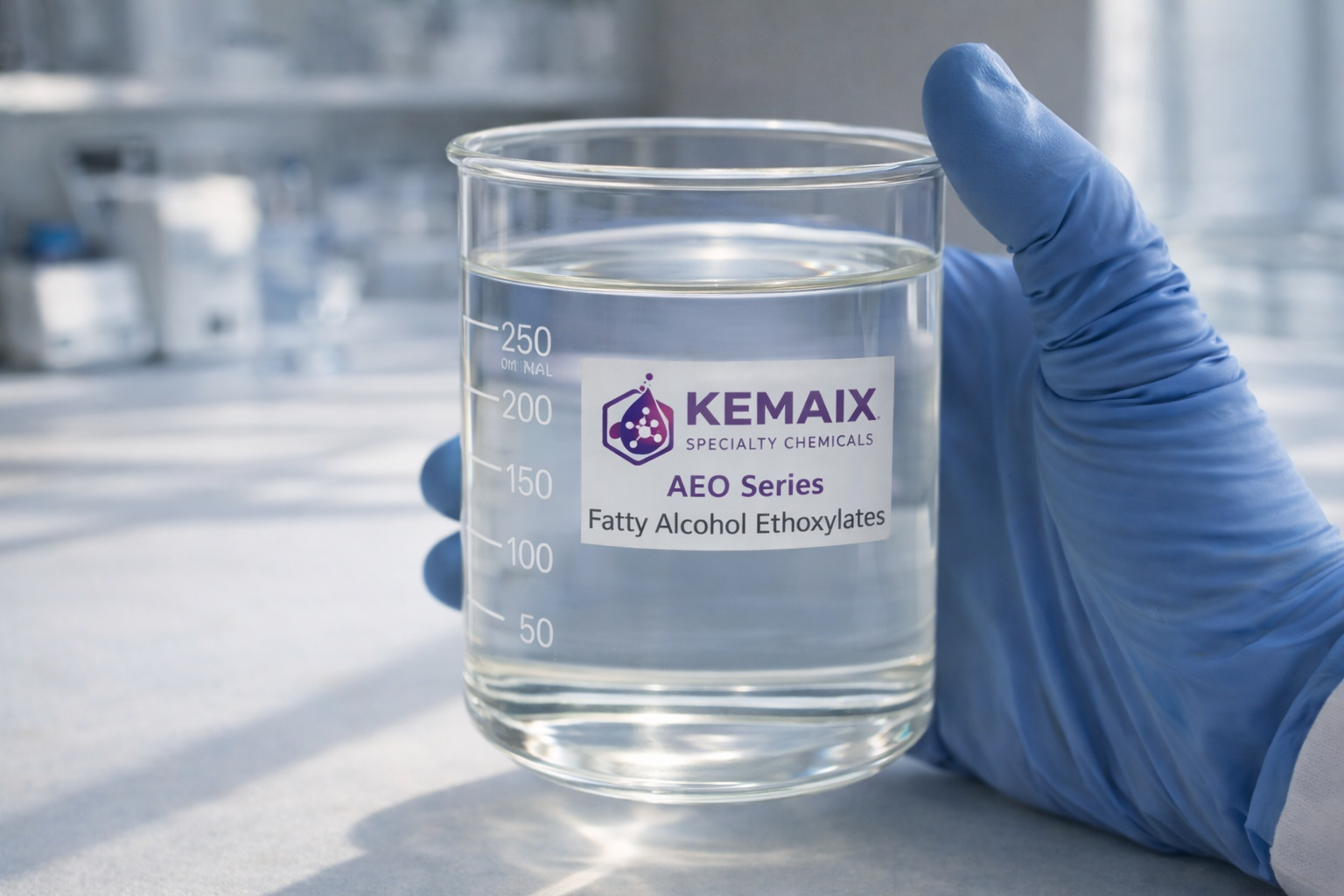
AEO Series
Fatty alcohol ethoxylates for wetting, scouring, detergency and emulsification. APEO-free status and custom EO-mole feasibility are grade-specific and must be confirmed.
View AEO specifications →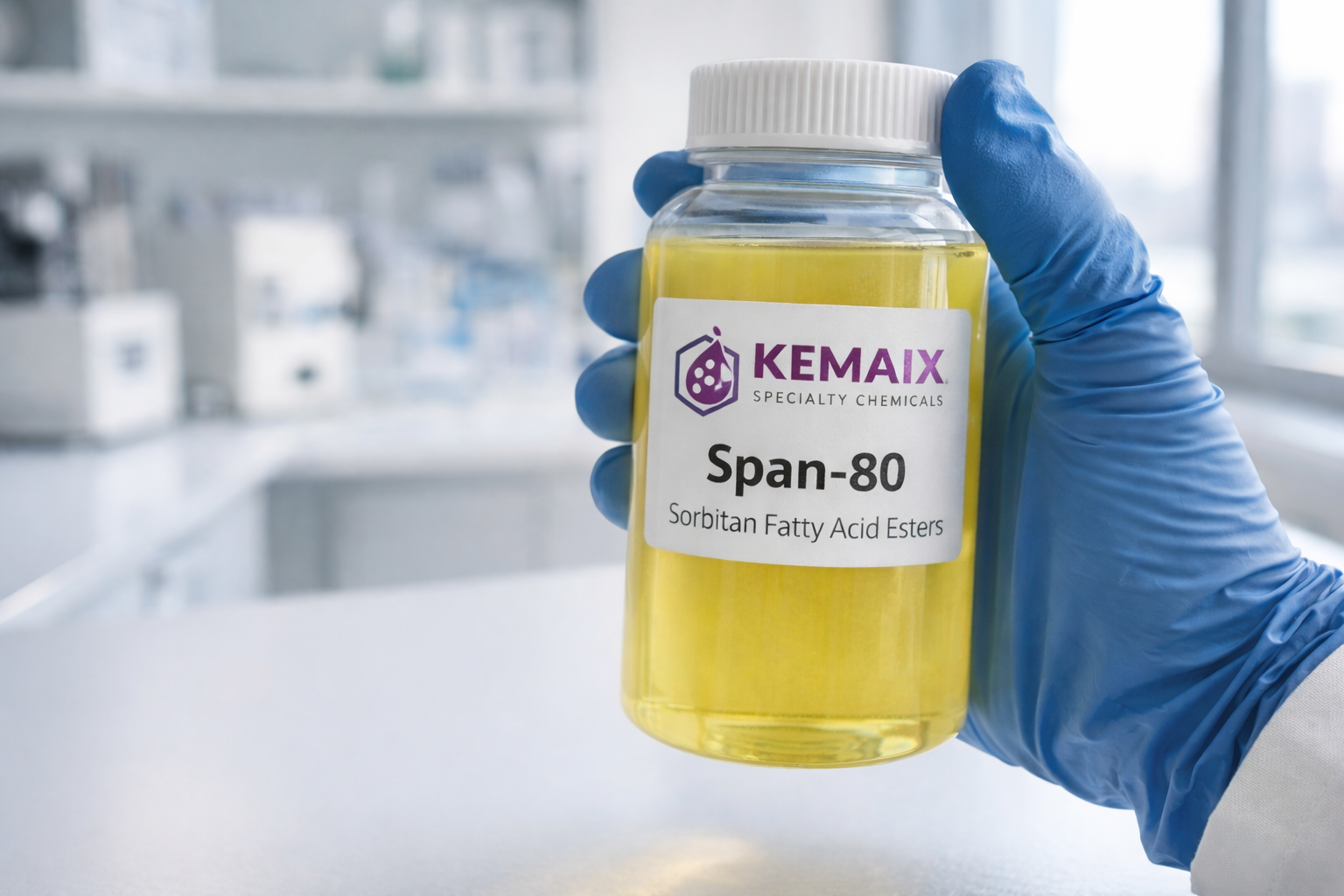
Span Series
Sorbitan fatty acid esters — the oil-soluble, low-HLB half of an emulsifier system. Standard W/O emulsifier for food, pharma, cosmetics and industry.
View Span specifications →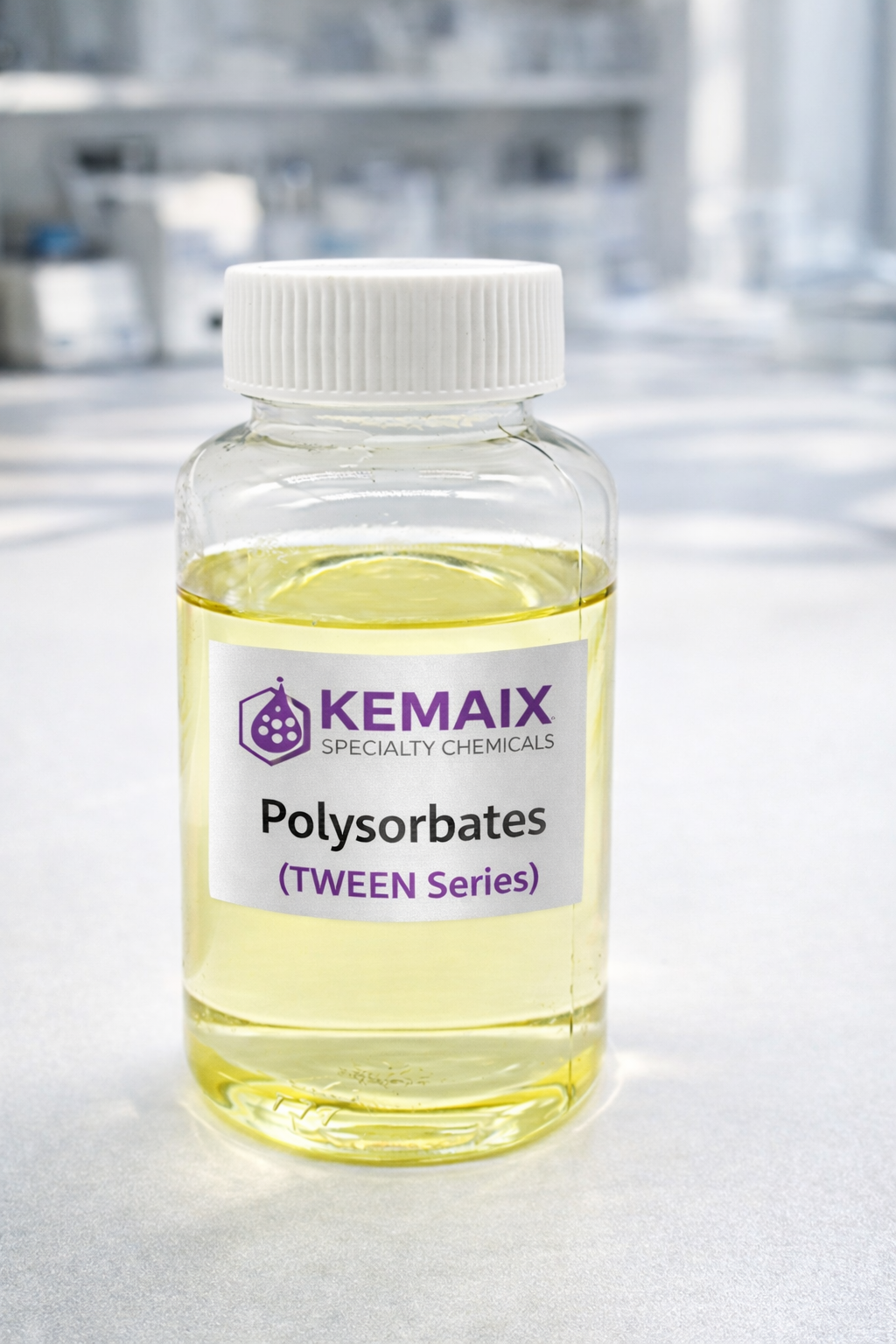
Tween Series
Polysorbates — the water-soluble, high-HLB counterpart to Span. O/W emulsification, solubilization and stabilization.
View Tween specifications →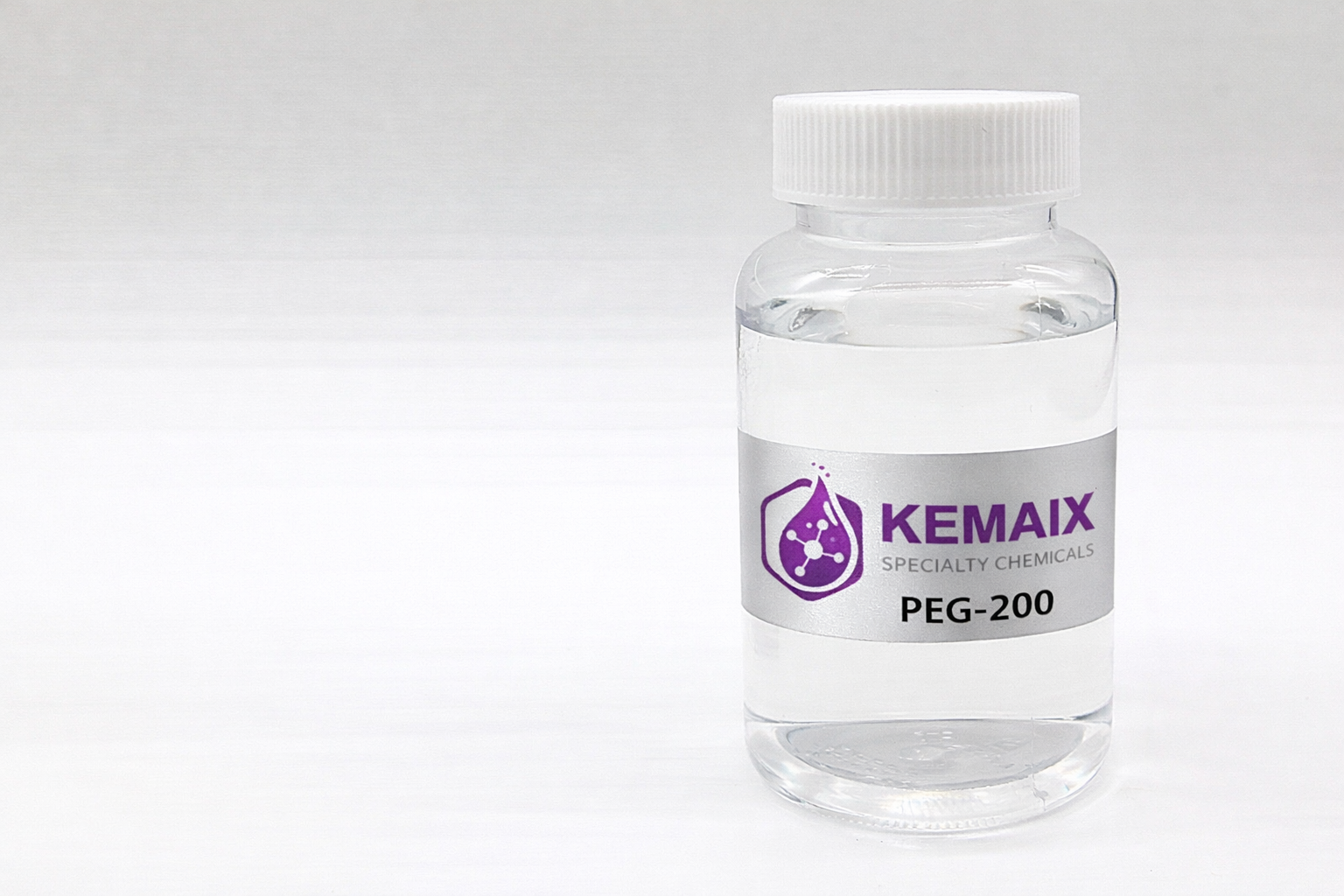
PEG Series
Polyethylene glycol from liquid to solid. Solvents, humectants, lubricants, binders and ointment bases across pharma, cosmetics and industry.
View PEG specifications →
PPG Series
Polypropylene glycol — more hydrophobic than PEG, giving superior lubricity and defoaming in oil-based and metalworking systems.
View PPG specifications →
EL Series
Ethoxylated castor oil covering a wide HLB span — emulsification and dispersion for agrochemicals, textile auxiliaries and coatings.
View EL specifications →
Block Polyether
EO/PO block copolymers (poloxamers) engineered for low-foam, defoaming, dispersing and shear protection — including F68 (Poloxamer 188).
View block polyether specifications →
Polyether Defoamer
Three EO/PO backbones for foam control in fermentation, papermaking, water treatment, concrete admixtures, textile and cleaning.
View defoamer specifications →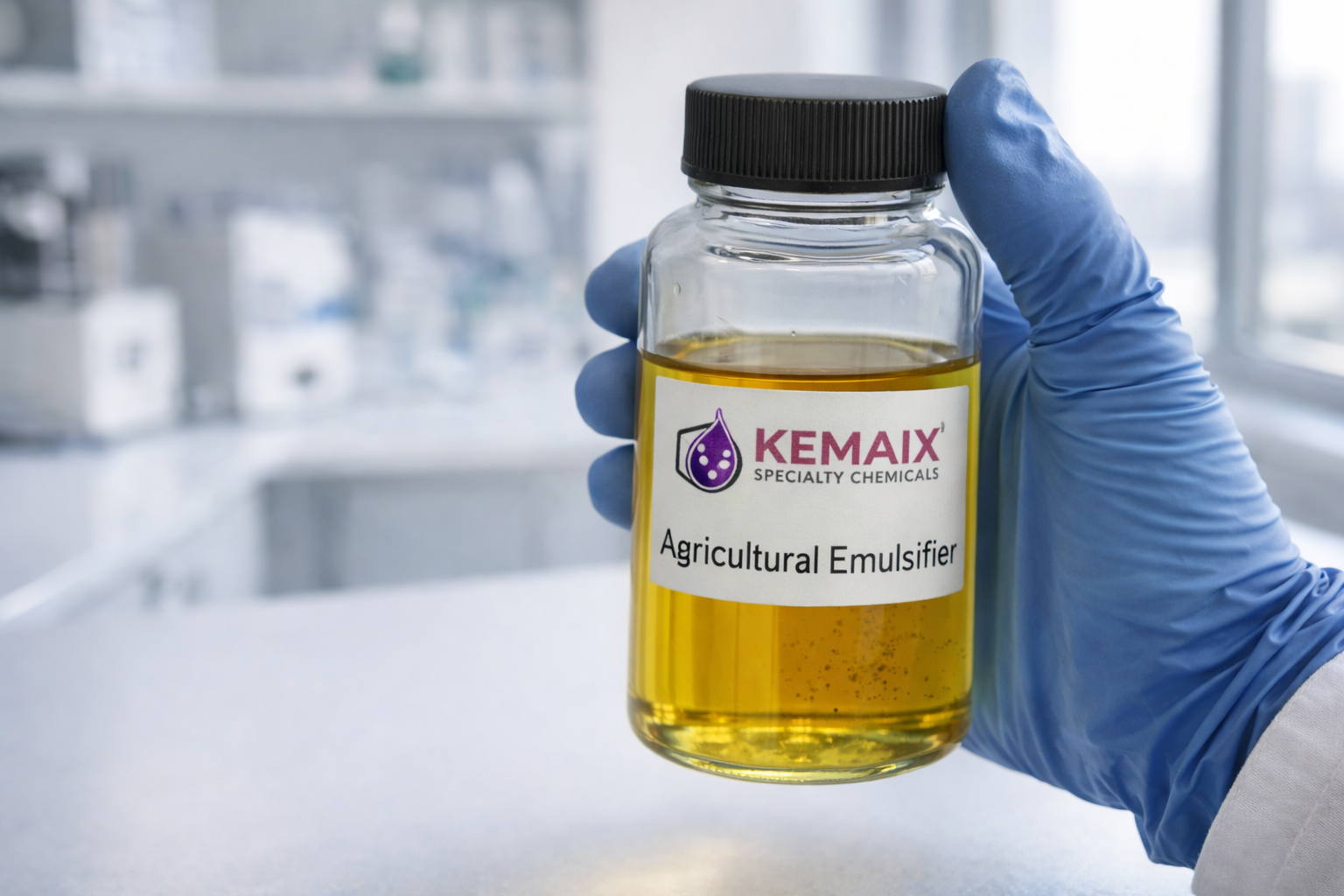
Agro-Emulsifier
Nonionic agricultural emulsifiers matched to EC, EW, SC, ME and WP pesticide systems, with documented active-ingredient compatibility.
View agro-emulsifier specifications →Cross-Family Surfactant Guides
Surfactant Performance Comparison
Compare wetting, foam, emulsification and application behavior across surfactant families.
Industrial Emulsification Mechanisms
Understand interfacial tension, droplet stabilization and demulsification mechanisms.
Emulsification and Solubilization
See how micelles, interfaces and formulation variables control emulsification and solubilization.
Surfactants in Mineral Flotation
Map collectors, frothers and modifiers to flotation performance and ore-processing conditions.
Glycerol Ethoxylate in Textile Dyeing
Review GPE performance in polyester-fiber wetting, dyeing and water-soluble formulations.
Compare All Nine Lines at a Glance
Start from the function you need, not the product name.
| Series | Chemistry | Grade Range | HLB | Solubility | Primary Function |
|---|---|---|---|---|---|
| AEO | Fatty alcohol ethoxylate | AEO-3 – AEO-23 | 6 – 18 | Oil → water soluble with EO | Wetting, scouring, detergency |
| Span | Sorbitan fatty acid ester | S-20 – S-85 | 1.8 – 8.6 | Oil-soluble | W/O emulsification (low-HLB anchor) |
| Tween | Polysorbate | T-20 / 40 / 60 / 80 | 14.5 – 16.5 | Water-soluble | O/W emulsification, solubilization |
| PEG | Polyethylene glycol | PEG-200 – 8000 | — | Water-soluble | Solvent, humectant, binder, base |
| PPG | Polypropylene glycol | PPG-200 – 8000 | — | Hydrophobic at higher MW | Lubricant, defoamer, dispersant |
| EL | Ethoxylated castor oil | EL-10 – EL-80 | 6 – 16.5 | Oil → water soluble with EO | Emulsification, dispersion |
| Block Polyether | EO/PO block copolymer | L / P / F series | 3 – 30 | Varies with EO content | Low-foam, defoaming, shear protection |
| Polyether Defoamer | EO/PO polyether | KM-DG / DA / DE | — | Inverse solubility | Foam control in aqueous systems |
| Agro-Emulsifier | Nonionic blends | 600# / BY / 400# / 1601# | — | Solvent & water compatible | Pesticide EC, EW, SC, ME, WP |
Values are typical. Request the grade-specific TDS and available batch COA for exact specifications, or ask us to assess project-specific adjustment feasibility.
Which Line Solves Your Problem
Agrochemical Formulation
Candidate emulsifier families for EC, EW, SC and ME systems. Electrolyte tolerance, emulsion stability and spreading must be validated in the finished formulation.
Agro-Emulsifier → EL Series →Textile & Auxiliary Chemicals
Candidate scouring, wetting and low-foam grades for textile processing. Verify pH, temperature, foam and substrate compatibility under the intended process conditions.
AEO Series → Polyether Defoamer →Industrial & Institutional Cleaning
Block-polyether and PPG candidates for automatic dishwashing and metal-cleaning systems. Validate detergency, foam profile and material compatibility in the finished formulation.
Block Polyether → PPG Series →Emulsions, Personal Care & Pharma
Span and Tween can be screened by required HLB for O/W or W/O systems, with PEG candidates for formulation use. Final suitability depends on the complete formulation and applicable requirements.
Span → Tween → PEG →Fermentation, Water Treatment & Papermaking
Polyether candidates for foam-control screening in fermentation, water treatment and papermaking. Silicone content, carryover risk and downstream compatibility are grade- and process-specific.
Polyether Defoamer → Block Polyether →Not Sure Yet?
The technical team can review available product data and confirm the applicable test scope, sample requirements and trial-project feasibility before work begins.
R&D Laboratory → Ask an Engineer →Frequently Asked Questions
Can Kemaix assess custom EO/PO or target-HLB projects?
Project feasibility is reviewed by chemistry, target properties, application and order requirements. Depending on the selected product family, the team can assess HLB value, EO/PO ratio, cloud point and molecular weight as project targets for emulsifier or industrial-defoamer screening; final scope is confirmed in writing.
What is the designed capacity for bulk surfactant orders?
Kemaix's manufacturing facility has designed annual capacity above 20,000 tons. Available volume, peak-demand allocation, stock and dispatch timing are confirmed per grade and order; standard stocked items may be prepared in 7–10 working days.
Which quality and regulatory documents should buyers verify?
Quality documentation and applicable procedures should be reviewed during supplier qualification. Buyers should verify grade-specific TDS/SDS, batch COA and substance-specific REACH status before approval.
Does Kemaix provide technical support for specific applications?
The technical team reviews inquiries for agrochemical surfactants, textile auxiliaries, industrial cleaning and construction chemicals. Available product data and the applicable laboratory test scope are confirmed for each project. Evaluation sample quantities may be 200–500 g when the selected grade and current availability permit; sample cost, courier charges and dispatch timing are confirmed before shipment.
Which product line should I start with?
It depends on the function you need — AEO for wetting and detergency, Span and Tween for emulsification by HLB pairing, PEG and PPG for solvency and lubrication, block polyethers and defoamers for foam control, and the agro range for pesticide formulation. The comparison matrix above maps each line to its primary function.
EO/PO Grade Review & Custom Project Assessment
Our EO/PO team has worked with these derivatives since 2010 and supports grade selection for target HLB, cloud point and solubility requirements. Send the application, target specification, quantity, destination and required documents; the team will confirm available grades, project feasibility, sample terms and quotation criteria.