
Evidence note: Capacity is a Kemaix company-reported operating metric, reviewed 13 August 2026. Confirm the current ISO certificate and its applicable scope. GB 25551-2010 is a reference standard; grade and intended-use applicability require current specification and batch-document review. Sample availability and standard lead time are service targets and must be confirmed in the written quotation.
Which Span Sorbitan Ester Should You Start With?
Definition: Span products are nonionic sorbitan fatty-acid esters with low HLB values and strong oil affinity. Select first by the oil phase's required HLB and fatty-acid compatibility, then calculate a Span/Tween blend when the target HLB lies between the two emulsifiers.
| Selection need | Starting grade | Typical HLB | Validate before scale-up |
|---|---|---|---|
| Higher-HLB Span or laurate compatibility | Span 20 / S-20 | 8.6 | Oil-phase required HLB and final emulsion type |
| Waxy palmitate or stearate structure | Span 40 / S-40 or Span 60 / S-60 | 6.7 or 4.7 | Melting, addition order and crystallization stability |
| Liquid oleate-based W/O emulsification | Span 80 / S-80 | 4.3 | Oxidation stability, acid value and oil compatibility |
| Very low-HLB trioleate system | Span 85 / S-85 | 1.8 | Required HLB, viscosity and long-term phase stability |
Data basis and limits: HLB and typical-property ranges are derived from the current Kemaix series specification reviewed 13 August 2026; they are not batch-release limits or blanket food approval. Confirm the grade-specific TDS, SDS and COA. For regulated food use, check the exact sorbitan ester, current jurisdiction and intended use. The WHO JECFA record for sorbitan monooleate shows substance-specific identity and the latest evaluation context.
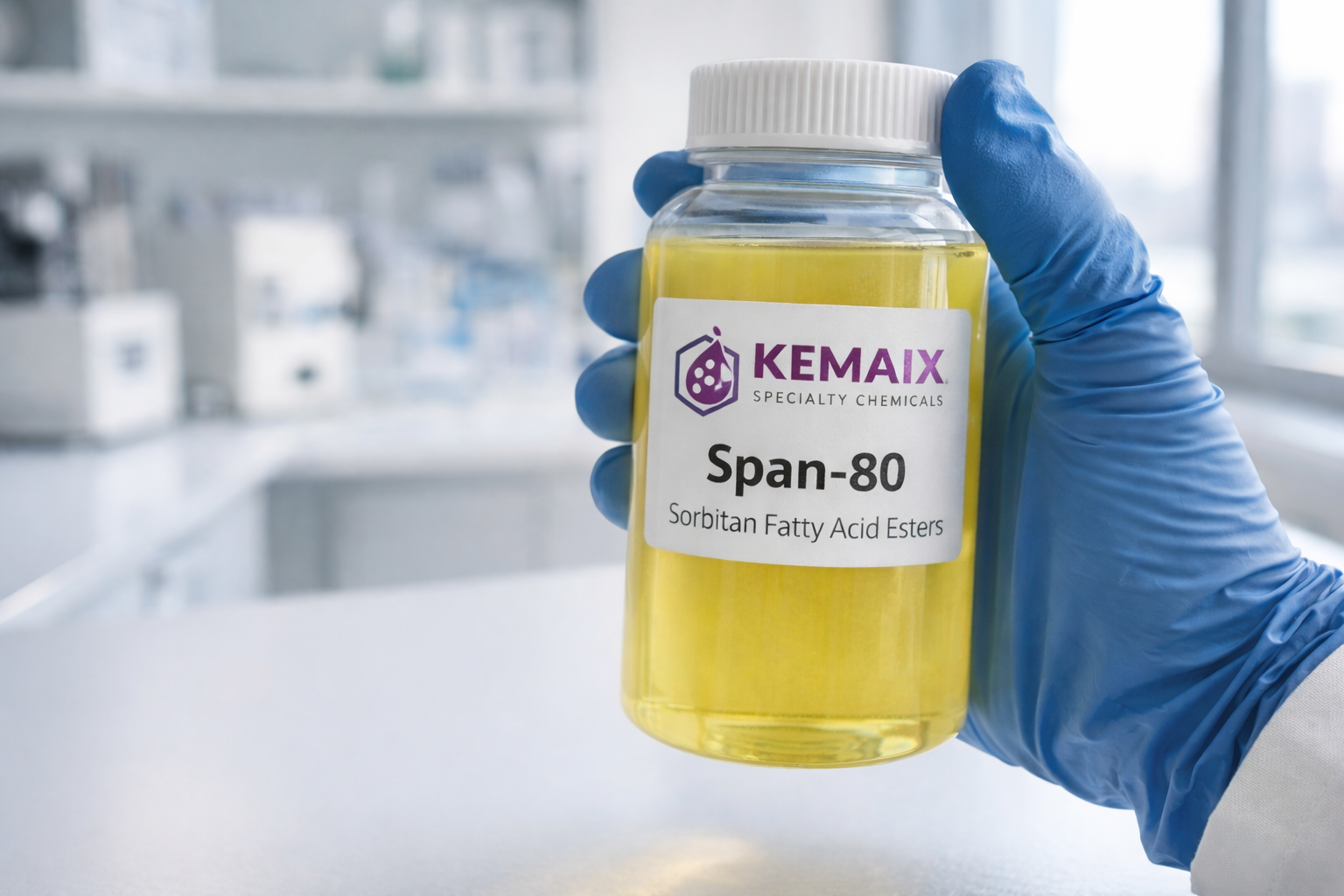
The Oil-Soluble Half of Every Emulsifier System
Span esters are produced by reacting sorbitol with fatty acids from vegetable oil fractionation. They are lipophilic, low-HLB nonionics — excellent water-in-oil emulsifiers on their own, and the anchor point when you blend to a target required HLB.
Which fatty acid is esterified sets the HLB: laurate gives 8.6, oleate 4.3, trioleate 1.8. Pairing a Span with a high-HLB Tween is the standard route to a stable emulsion at almost any required HLB.
- CAS Number1338-43-8 (Span 80) / 1338-41-6 (Span 60)
- Chemical CompositionSorbitan fatty acid esters
- Ionic TypeNonionic
- HLB Range1.8 – 8.6
- SolubilityOil-soluble; soluble in polar organic solvents
- Reference StandardGB 25551-2010; confirm grade and intended-use scope
Span Series Technical Specifications
| Grade | Appearance (25°C) | Hydroxyl Value (mgKOH/g) | Saponification Value (mgKOH/g) | Acid Value (mgKOH/g) | Moisture (%) | HLB | Melting Point (°C) |
|---|---|---|---|---|---|---|---|
| S-20 | Amber viscous liquid | 330–360 | 160–175 | ≤ 8 | ≤ 1.5 | 8.6 | Liquid (25°C) |
| S-40 | Yellow waxy solid | 255–290 | 140–150 | ≤ 8 | ≤ 1.5 | 6.7 | 45–47 |
| S-60 | Light yellow waxy solid | 240–270 | 135–155 | ≤ 8 | ≤ 1.5 | 4.7 | 52–54 |
| S-80 | Amber viscous liquid | 190–220 | 140–160 | ≤ 10 | ≤ 1.5 | 4.3 | Liquid (25°C) |
| S-85 | Yellow oily liquid | 60–80 | 165–185 | ≤ 15 | ≤ 1.5 | 1.8 | Liquid (25°C) |
Span 65 (sorbitan tristearate) and Span 83 (sorbitan sesquioleate) are also produced — request the grade-specific TDS for their parameters.
Where Span Esters Are Used
W/O Emulsification
The core role. Widely used as emulsifiers for water-in-oil systems across industrial and consumer formulations.
Agrochemical Formulations
Used in pesticides as emulsifiers, dispersants and wetting agents, often blended with anionics for EC systems.
Food, Cosmetics & Pharma
Span 20, 40 and 60 improve fat dispersion in bakery products and stabilise creams and ointments against crystallisation.
Industrial & Specialty
Span 80 and 83 disperse mineral and vegetable oils in emulsion explosives, oil-based drilling fluids and metalworking lubricants; Span 60 doubles as a textile antistatic and lubricant.
Selection & Handling Notes
⚠ Span alone rarely hits your target HLB
Most oil phases need a blend. Pair a low-HLB Span with a high-HLB Tween and calculate the ratio against your phase's required HLB.
⚠ Solid grades need melting in
S-40 and S-60 are waxy solids. Melt and disperse them into the oil phase before emulsification rather than adding as flakes.
⚠ Check acid value for sensitive actives
Acid value ranges differ by grade (≤8 to ≤15). For pH-sensitive actives, specify the tighter grades.
⚠ Food or pharma use needs the right grade
Confirm the applicable specification for your market and request documentation before formulating a regulated product.
Packaging, Storage & Shipping
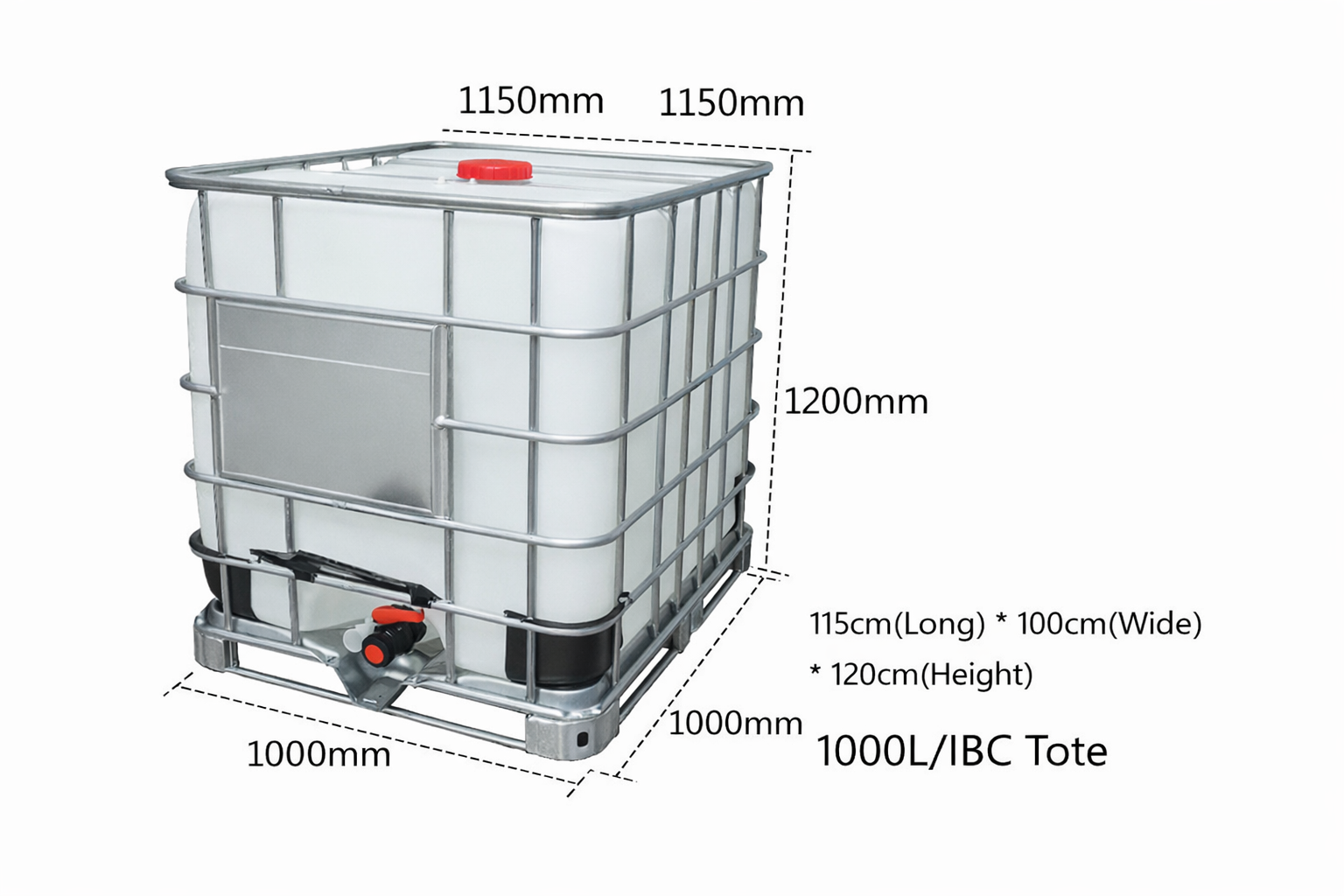
Packaging: Solid grades (S-40, S-60) in 25 kg composite woven bags with PE liner. Liquid grades (S-20, S-80, S-85) in 25 kg, 200 kg drums or 1000 kg IBC.
Storage: Cool, dry and well-ventilated conditions with containers kept closed. Shelf life 2 years from date of manufacture.
Shipping: FOB, CIF and CFR as FCL or LCL via Shanghai Port, with TDS, SDS and COA available for customs and customer regulatory review. Confirm REACH registration, Only Representative coverage and intended-use applicability for the specific grade and destination market.
Frequently Asked Questions
Technical resources: Use the Span 80/Tween 80 HLB calculator and worked blend examples; and review the Span 80 industrial benefits and selection guide.
What is Span used for?
Span sorbitan esters are low-HLB, oil-soluble emulsifiers used mainly for water-in-oil emulsions, and as the lipophilic partner in Span/Tween blends across agrochemicals, cosmetics, food and industrial systems.
What is the HLB of Span 80?
Span 80 (sorbitan monooleate) has an HLB of 4.3, making it oil-soluble and well suited to W/O emulsification and to blending with high-HLB Tween.
Is Span water-soluble?
No. Span esters are oil-soluble. They are commonly paired with water-soluble high-HLB Tween polysorbates to reach a target required HLB.
What is the difference between the Span grades?
They differ in the fatty acid esterified to sorbitan — laurate (S-20), palmitate (S-40), stearate (S-60), oleate (S-80) and trioleate (S-85) — giving HLB values from 8.6 down to 1.8.
How do I blend Span and Tween to a target HLB?
Use the weighted formula: % high-HLB = (target HLB - low HLB) / (high HLB - low HLB) x 100. Our laboratory can run the HLB mapping and emulsion stability testing for you.
Do Kemaix Span products meet a national standard?
GB 25551-2010 is listed as a reference standard for this series. Confirm the applicable grade, intended use and current specification, and request the batch COA before qualification.
Need a Span/Tween Blend Matched to Your Oil Phase?
Send us the oil or wax you need to emulsify and the target system, and we will calculate the blend ratio, supply TDS and COA, and arrange 200–500 g samples.