
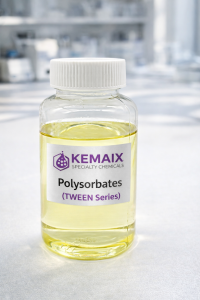
Tween 80 Industrial Applications: Functional Roles of Polysorbate 80 in Modern Industrial Systems

Why Tween 80 Remains Relevant in Industrial Formulations?

Tween 80 Industrial Applications

Analyzing Tween 80 industrial applications reveals its critical role as a high-HLB non-ionic surfactant in modern industrial chemistry. Chemically known as Polysorbate 80, its ability to stabilize Oil-in-Water (O/W) emulsions under mechanical stress makes it indispensable for sectors ranging from coatings to oilfield drilling.

Interfacial Mechanisms Behind Tween 80 Industrial Applications

The efficacy of Tween 80 industrial applications stems from its unique non-ionic structure, which provides steric stabilization rather than relying solely on electrostatic forces. Nonionic character can support brine compatibility, but salinity, temperature, hardness, oil composition and other additives must be tested in the complete system.

• Coatings & Inks A wetting candidate whose effect on flooding, floating, color development and storage stability should be measured in the finished coating or ink.
• Textile & Dyeing Functions as a leveling agent, ensuring dye liquor penetrates fibers evenly for consistent shade control.

Formulation Logic: Managing Foaming and Shear

While Tween 80 industrial applications are diverse, formulators must optimize dosage to avoid excessive foaming during high-shear mixing. At Kemaix, we recommend pairing Tween 80 with suitable anti-foaming agents or adjusting the EO chain concentration for specific industrial systems.

Our industrial-grade Tween 80 is specifically refined to minimize residual impurities, ensuring that it remains chemically inert when used alongside aggressive industrial additives or pH-sensitive binders.

Optimization Guide: Tween 80 Dosage in Industrial Systems

To maximize Tween 80 industrial applications, precise concentration control is essential to balance emulsification efficiency and cost-effectiveness. The following supplier ranges are formulation-screening points, not validated use levels. Confirm the grade, active content, test method and finished-system performance:

Industrial Sector Typical Dosage (%) Technical Role
Oilfield Chemicals 1.5% – 4.0% Emulsion breaking & paraffin inhibition
Agrochemical SC/EW 3% – 10% Solubilization of active ingredients
Industrial Coatings 0.5% – 2.0% Pigment wetting and anti-settling
Textile Processing 2% – 5% Leveling agent for synthetic fibers

Calculating the Target HLB with Tween 80 and Span 80

A cornerstone of Tween 80 industrial applications is its synergy with Span 80. Since Tween 80 has an HLB of 15.0 and Span 80 has an HLB of 4.3, they can be blended to reach a specific “Required HLB” for any oil phase. The calculation formula is as follows:

$HLB_{blend} = (W_A \times HLB_A + W_B \times HLB_B) / (W_A + W_B)$

For example, to achieve a target HLB of 10.0 for a mineral oil emulsion, a ratio of approximately 53% Tween 80 and 47% Span 80 is required. Use current specifications and batch COAs for both surfactants, then confirm that the calculated blend HLB produces the required stability at production scale.

Storage and Handling for Large-Scale Supply

Due to the polyoxyethylene chains in its structure, Tween 80 is sensitive to oxidation and temperature fluctuations. To maintain the integrity of Tween 80 industrial applications, Kemaix recommends storing the product in a cool, dry place, away from direct sunlight.

  • Shelf Life: 24 months in original, unopened packaging.
  • Viscosity Note: Tween 80 may thicken at lower temperatures; gentle warming and stirring will restore its liquid state without affecting performance.
  • Packaging: Available in 200kg drums or 1000kg IBC tanks for bulk industrial use.

Technical FAQ

Q: What is the HLB value of Tween 80?

A: Tween 80 has an HLB value of 15.0. Its high hydrophilicity makes it a common screening candidate for O/W emulsification and limited oil solubilization; loading and stability remain formulation-specific.

A: Being non-ionic, Tween 80 does not react with salts or minerals in the wellbore. This provides superior stability in high-salinity brine environments where ionic surfactants might precipitate or fail.

A: Yes, Tween 80 is broadly compatible with most resins, polymers, and corrosion inhibitors. It is often paired with low-HLB surfactants like Span 80 to achieve a specific target HLB for custom formulations.

A: It acts as a wetting agent that lowers the surface tension of the liquid binder, allowing it to penetrate pigment clumps easily. This ensures a uniform color and prevents “floating” defects in the dried film.

Reliable Supply for Tween 80 Industrial Applications

From oilfield drilling fluids to pigment dispersions, Kemaix provides high-purity Polysorbate 80 with consistent batch quality and full technical documentation (TDS/MSDS).

Request Bulk Pricing & Samples

Direct answer: Tween 80 is a hydrophilic nonionic emulsifier whose grade must match the end use

Tween 80 (polysorbate 80; polyoxyethylene (20) sorbitan monooleate) can be screened for O/W emulsification, solubilization, wetting and compatibility support. Industrial suitability depends on oil phase, hydrophobe loading, temperature, salts, shear and storage. Food, pharmaceutical and cosmetic conclusions require the correct grade, specification, impurities, documentation and market authorization.

Application roleTween 80 screening contributionWhat to verify
O/W emulsionHydrophilic primary or co-emulsifierDroplet size, creaming, coalescence and temperature cycling
SolubilizationMicellar support for limited hydrophobe loadingClarity, phase boundary and dilution path
Span/Tween blendHydrophilic component for blend adjustmentBlend ratio and finished-emulsion stability
Industrial processingNonionic wetting and compatibility candidateFoam, residue and interaction with other additives
Regulated useChemistry name alone is insufficientCompendial/food/cosmetic grade and intended-use documentation

Evidence boundary: the JECFA specification defines food-additive identity and quality parameters for polysorbate 80; it does not convert an unspecified industrial grade into a compliant regulated-use material.

Technical review: Grace Dou, emulsifier applications team. Reviewed 14 August 2026.

Primary references

Build blends with the Span/Tween guide and compare with the Span 80 industrial guide.

Picture of Grace Dou

Grace Dou

Technical Content Reviewer. Grace Dou is a technical content reviewer at Nanjing Kemaix Advanced Materials Co., Ltd., focusing on EO/PO derivatives, nonionic surfactants, formulation scope, test conditions and documentation boundaries. Final grade selection should use current specifications and finished-formula testing.

Scroll to Top