
Evidence note: Capacity is a Kemaix company-reported operating metric, reviewed 13 August 2026. Confirm the current ISO certificate and its applicable scope. Sample availability and standard lead time are service targets and must be confirmed in the written quotation.
Which Tween Polysorbate Should You Start With?
Definition: Tween polysorbates are high-HLB, polyoxyethylene sorbitan fatty-acid esters used mainly for oil-in-water emulsification and solubilization. Grade choice depends on the fatty-acid moiety, required HLB, oil compatibility, clarity target and the applicable purity specification.
| Selection need | Starting grade | Typical HLB | Validate before scale-up |
|---|---|---|---|
| High-HLB laurate solubilization | Tween 20 / T-20 | 16.5 | Clarity, fragrance or oil loading and foam |
| Palmitate-based O/W emulsification | Tween 40 / T-40 | 15.5 | Melting, addition order and storage temperature |
| Stearate-based O/W emulsification | Tween 60 / T-60 | 14.5 | Oil compatibility, crystallization and viscosity |
| Oleate-based emulsification or solubilization | Tween 80 / T-80 | 15.0 | Peroxide/acid value, oxidation and final stability |
Data basis and limits: HLB and typical-property ranges are derived from the current Kemaix series specification reviewed 13 August 2026; they are not batch-release limits or evidence of food/pharmaceutical approval. Confirm the grade-specific TDS, SDS and COA. The official FAO/JECFA Polysorbate 80 specification record identifies polyoxyethylene (20) sorbitan monooleate as INS 433; market, route, formulation and current-monograph requirements still require separate review.
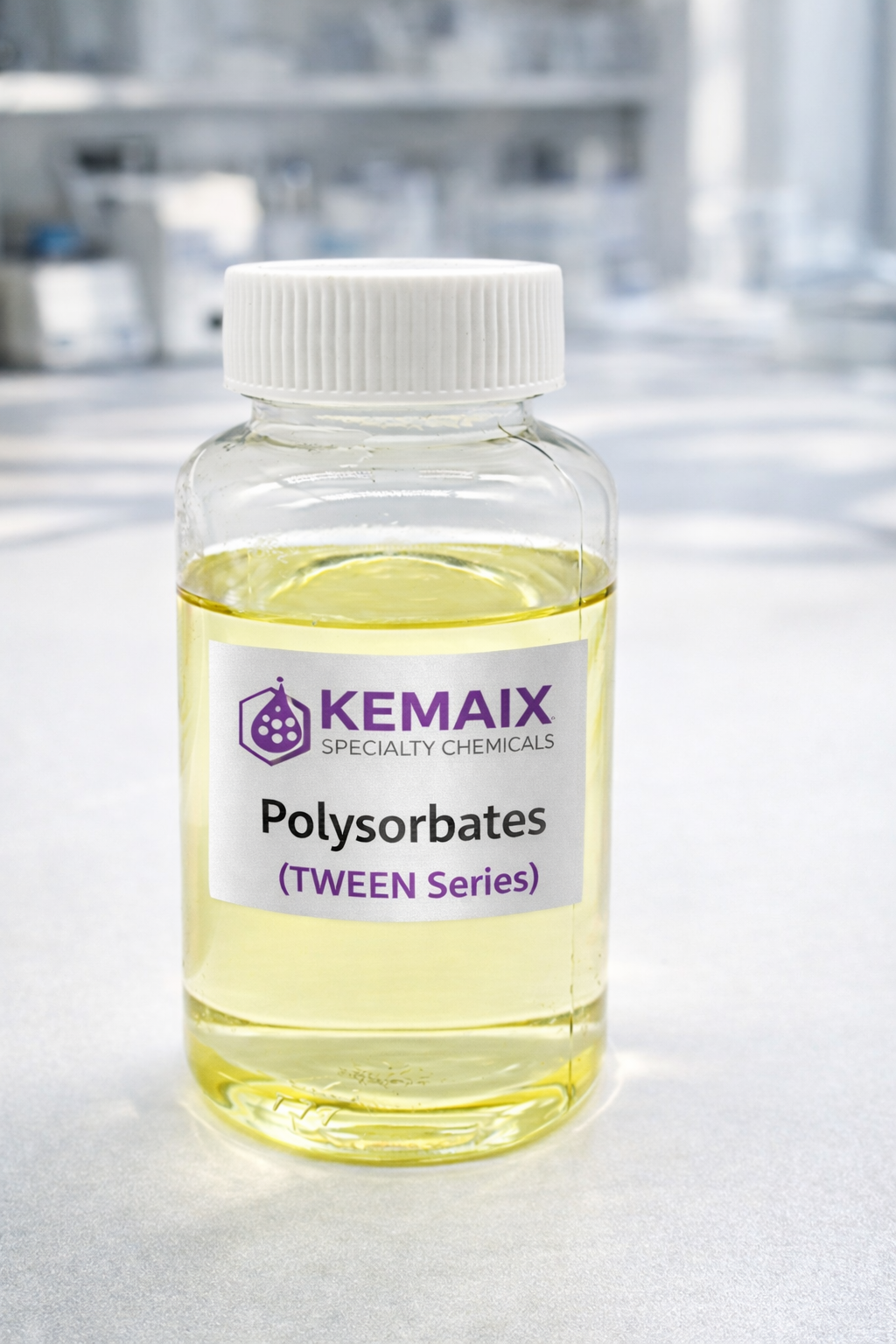
The Water-Soluble Counterpart to Span
Tween polysorbates are made by ethoxylating sorbitan esters. That added EO chain flips the molecule from oil-soluble to water-soluble, taking HLB from Span's 1.8–8.6 up into the 14–17 range.
The result is a hydrophilic nonionic that emulsifies oil into water, solubilizes fragrance and essential oils into clear aqueous systems, and stabilises emulsions against separation. Blended with Span, it lets you dial in almost any required HLB.
- CAS Number9005-65-6 (Tween 80)
- Chemical CompositionPolyoxyethylene sorbitan fatty acid esters
- Molecular FormulaC64H124O26 (Tween 80)
- Ionic TypeNonionic
- HLB Range14.5 – 16.5
- SolubilityWater-soluble; also soluble in alcohols and polar solvents
Tween Series Technical Specifications
| Grade | Appearance (25°C) | Hydroxyl Value (mgKOH/g) | Saponification Value (mgKOH/g) | Acid Value (mgKOH/g) | Moisture (%) | HLB | Specific Gravity |
|---|---|---|---|---|---|---|---|
| T-20 | Amber viscous liquid | 85–110 | 35–50 | ≤ 2.0 | ≤ 3 | 16.5 | 1.08–1.13 |
| T-40 | Light yellow waxy solid | 85–100 | 40–55 | ≤ 2.0 | ≤ 3 | 15.5 | 1.05–1.10 |
| T-60 | Light yellow waxy solid | 80–105 | 40–55 | ≤ 2.0 | ≤ 3 | 14.5 | 1.05–1.10 |
| T-80 | Amber viscous liquid | 60–85 | 40–50 | ≤ 2.0 | ≤ 3 | 15 | 1.06–1.09 |
Additional polysorbate grades are produced on request. Specify the grade and application when requesting a TDS.
Where Polysorbates Are Used
O/W Emulsification
The primary role — emulsifying oil into water for creams, lotions, sauces and industrial emulsions.
Solubilization
Above its critical micelle concentration, Tween brings fragrance and essential oils into clear aqueous solution.
Agrochemical Formulations
Used as emulsifiers, dispersants and wetting agents in pesticide formulations, often paired with Span.
Regulated Applications
Polysorbates appear in food-additive and pharmaceutical-excipient specifications, but suitability depends on the exact grade, jurisdiction, route, formulation and current monograph. Request the applicable documentation before qualification.
Selection & Handling Notes
⚠ Watch acid value and peroxides on ageing
Oxidation raises acid value and peroxide content. For sensitive actives, specify low-peroxide material and store cool and sealed.
⚠ Regulated use needs the right grade
Food, cosmetic and pharmaceutical applications each have their own requirements. Confirm compliance and request the COA before formulating.
⚠ Batch consistency shifts effective HLB
A drift in saponification or acid value moves the effective HLB. Insist on traceable batch data for critical emulsions.
⚠ Pair with Span, don't over-dose alone
Reaching a target HLB with a Span/Tween blend uses less total surfactant than pushing Tween alone, and gives a more stable interface.
Packaging, Storage & Shipping
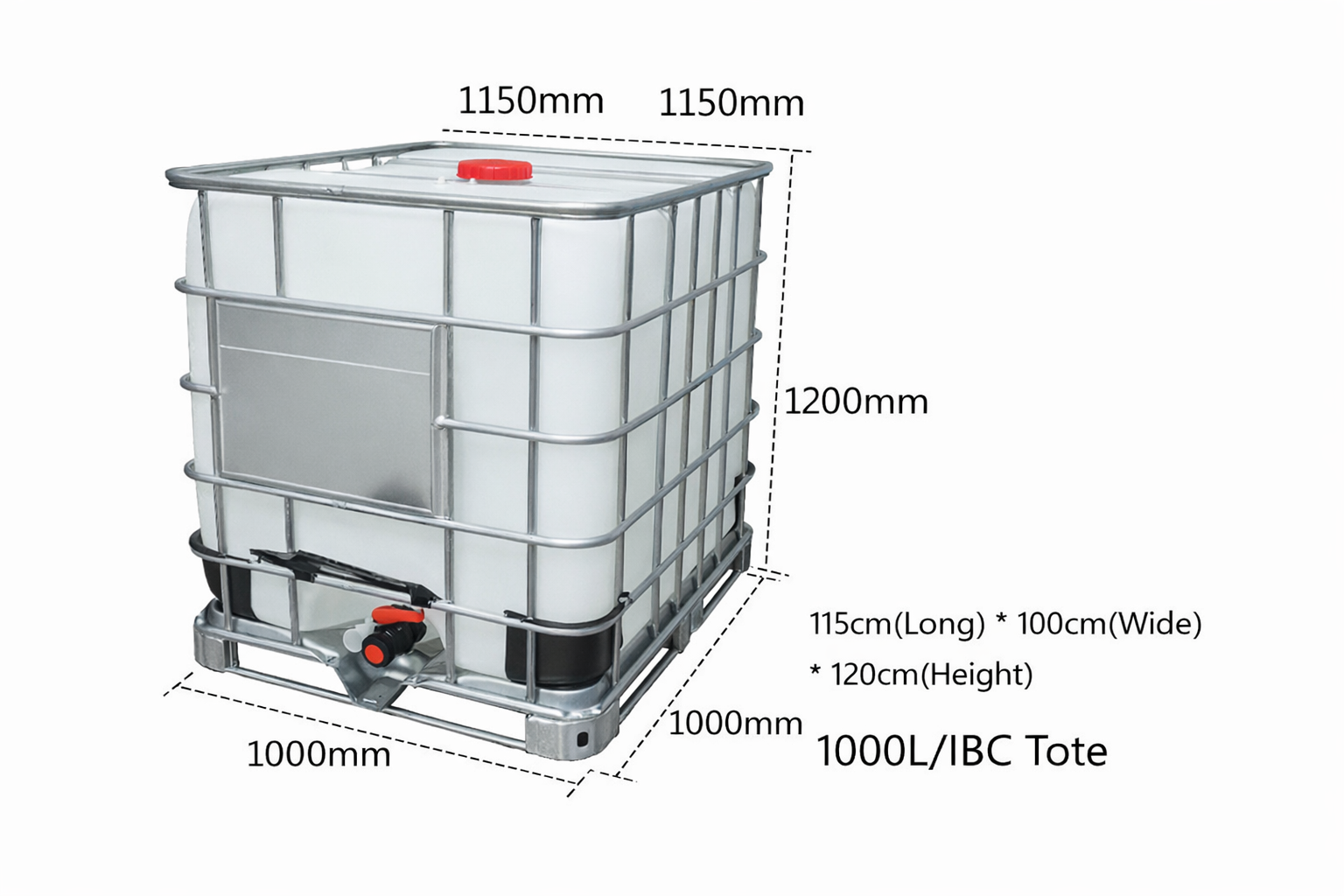
Packaging: Liquid grades in 200 kg drums or 1000 kg IBC. Waxy solid grades (T-40, T-60) in 25 kg or 200 kg drums.
Storage: Cool, dry and well-ventilated conditions with containers kept closed. Shelf life 2 years from date of manufacture.
Shipping: FOB, CIF and CFR as FCL or LCL via Shanghai Port, with TDS, SDS and COA available for customs and customer regulatory review. Confirm REACH registration, Only Representative coverage and intended-use applicability for the specific grade and destination market.
Frequently Asked Questions
Technical resources: Use the Span 80/Tween 80 HLB calculator and worked blend examples; and review Polysorbate 80 in food and pharmaceutical formulations.
What is polysorbate (Tween)?
Tween polysorbates are water-soluble nonionic surfactants made by ethoxylating sorbitan esters. They are high-HLB O/W emulsifiers and solubilizers used across food, pharmaceutical, cosmetic and industrial formulations.
What is the HLB of Tween 80?
Tween 80 (Polysorbate 80) has an HLB of 15, making it a hydrophilic surfactant suited to oil-in-water emulsification and solubilization.
Can Tween 80 be used in food and pharmaceuticals?
Polysorbate 80 is identified as INS 433 in the FAO/JECFA specification system and is used as an excipient in some medicines. Suitability is grade-, route-, formulation- and jurisdiction-specific; confirm the current monograph, intended use and supplier documentation.
What is the difference between Span and Tween?
Span esters are low-HLB and oil-soluble, suited to W/O systems. Tween polysorbates are high-HLB and water-soluble, suited to O/W systems. They are often blended to hit a target required HLB.
What is the difference between Tween 20, 60 and 80?
They differ in the fatty acid esterified to sorbitan — laurate (T-20), stearate (T-60) and oleate (T-80) — giving slightly different HLB values and application fit.
Do you supply bulk Tween 80 with specific acid value limits?
Custom limits can be reviewed against manufacturing and analytical feasibility. Confirm acid value, moisture, peroxide-related requirements and release limits in the written specification.
Need Tween to a Specific HLB or Acid Value?
Tell us your application, target specification and volume — we will confirm the grade, supply TDS and COA, and send 200–500 g for evaluation.