
Span 80 vs Tween 80: HLB Blend Calculation and Emulsion Testing
Span 80 vs Tween 80: the short answer
Span 80 has an HLB of about 4.3 and is oil-soluble, so it is commonly used in water-in-oil systems. Tween 80 has an HLB of about 15.0 and is water-dispersible, so it is commonly used in oil-in-water systems. Blending them lets a formulator match the required HLB of an oil phase.
Tween 80 (%) = (target HLB − 4.3) ÷ (15.0 − 4.3) × 100. The remainder is Span 80. Treat the result as a laboratory starting point, then verify stability at the formulation’s actual concentration, temperature, pH and shear.
Span 80 and Tween 80 comparison
| Property | Span 80 | Tween 80 |
|---|---|---|
| Chemical family | Sorbitan monooleate | Polyoxyethylene sorbitan monooleate |
| Typical HLB | 4.3 | 15.0 |
| Affinity | More lipophilic; oil-soluble | More hydrophilic; water-dispersible |
| Typical role | W/O emulsifier or low-HLB blend component | O/W emulsifier, solubilizer or high-HLB blend component |
| Kemaix product data | Span series | Tween series |
Span 80 / Tween 80 HLB calculator
Enter a target between 4.3 and 15.0. Results are weight percentages of the surfactant blend, not percentages of the finished formulation.
For HLB 10.5: 57.9% Tween 80 + 42.1% Span 80.
Worked blend examples
| Target HLB | Tween 80 | Span 80 | Interpretation |
|---|---|---|---|
| 8.0 | 34.6% | 65.4% | Lower-HLB starting blend |
| 10.5 | 57.9% | 42.1% | Worked mineral-oil example; confirm the actual oil’s required HLB |
| 12.0 | 72.0% | 28.0% | Higher-HLB starting blend |
Required-HLB values vary with oil identity, supplier, composition and test method. Run an HLB ladder around the calculated point and test accelerated, freeze–thaw and process-temperature stability before scale-up.
Data basis, sources and when the formula is not enough
The 4.3 and 15.0 HLB values are typical reference values used for blend screening. The percentages are an arithmetic split within the surfactant blend; they are not the total surfactant dosage and do not predict shelf life. Confirm identity and batch properties from the current Span 80 and Tween 80 TDS/COA, then run an HLB ladder around the calculated point.
For food or other regulated uses, verify the exact substance and current market requirements. Official references include the WHO JECFA sorbitan monooleate record and the FAO/JECFA Polysorbate 80 specification record. These records do not approve a particular Kemaix grade or finished emulsion.
Technical review: Grace Dou · Last reviewed 13 August 2026.
Span 80 and Tween 80 FAQ
Can Span 80 and Tween 80 guarantee a stable emulsion?
No. The HLB calculation selects a rational starting ratio, but stability also depends on total emulsifier level, oil composition, temperature, pH, electrolytes, droplet size and processing shear.
Is the calculator result a percentage of the finished formula?
No. It is the percentage split within the Span 80/Tween 80 surfactant blend. The total surfactant dosage must be established separately by formulation trials.
What if the target HLB is outside 4.3–15.0?
This pair cannot mathematically reach a value outside that range. Select a different low- or high-HLB emulsifier, or use a broader surfactant system.
Where can I get grade-specific specifications?
Review the Span and Tween product pages, then request the current TDS and batch COA.
Related: surfactant product portfolio · HLB mapping and emulsion testing · technical consultation
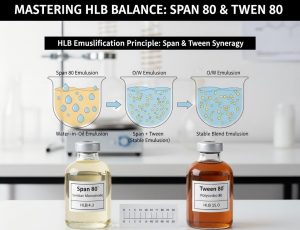
The HLB Algebra: How to Calculate the Ratio
To achieve a specific Required HLB (RHLB) for your oil phase, you must blend Span 80 (HLB 4.3) and Tween 80 (HLB 15.0) using the following formula:
Blending Formula:
% Tween 80 = [(Target HLB – HLB of Span 80) / (HLB of Tween 80 – HLB of Span 80)] × 100
Example: To emulsify mineral oil (Required HLB = 10.5):
% Tween 80 = [(10.5 – 4.3) / (15.0 – 4.3)] = 6.2 / 10.7 = 57.9%
% Span 80 = 42.1%
Required HLB (RHLB) for Industrial Oils
| Oil Phase | RHLB (O/W) | Recommended Blend |
|---|---|---|
| Paraffinic Mineral Oil | 10.0 – 11.0 | High Tween 80 Ratio |
| Castor Oil / Veg Oils | 7.0 – 9.0 | Balanced Span/Tween |
| Mineral Spirits | 13.0 – 14.0 | Pure Tween 80 Driven |
Beyond Algebra: Temperature and the PIT Effect
While the Span 80 and Tween 80 HLB guide provides a reliable theoretical starting point, industrial formulators must account for temperature fluctuations. For non-ionic surfactants, the hydrophilic nature of the polyoxyethylene chains in Tween 80 decreases as temperature rises.
The PIT is the temperature at which an O/W emulsion inverts into a W/O emulsion. If your industrial mixing process involves high-shear heating, your calculated HLB may shift. A temperature margin can be included as a laboratory screening rule, but the required margin is formulation-specific. Measure phase behaviour and stability across the actual process and storage range.
At Kemaix, we help clients navigate these thermal challenges by providing surfactants with high cloud points and consistent molecular weight distributions, ensuring that your industrial emulsification mechanism remains robust from the laboratory to the production floor.
The Role of Batch Consistency in Emulsion R&D
A common frustration in surfactant R&D is when a successful lab trial fails at the pilot scale. Often, this is not due to a calculation error in the Span 80 and Tween 80 HLB guide, but due to batch-to-batch variance in raw materials.
Standard industrial surfactants can have a variance of ±0.5 in their HLB values depending on the source. Kemaix mitigates this risk through:
- Controlled Esterification: Review the current Span 80 specification and applicable batch COA, then confirm blend performance in the finished emulsion.
- Traceable Hydroxyl Values: Allowing for precise RHLB matching in sensitive agrochemical and cosmetic formulations.
- Moisture Monitoring: Preventing unwanted shifts in the lipophilic-hydrophilic balance during long-term storage.
Technical FAQ: Mastering Span 80 and Tween 80 HLB Calculations
Question 1: How does temperature affect the HLB calculation?
Answer: Temperature is a critical variable. For non-ionic surfactants like Tween 80, the hydrophilic chains become less hydrated as temperature rises. This is known as the Phase Inversion Temperature (PIT). If your process involves heat, you may need to increase the Tween 80 ratio to maintain the target HLB.
Question 2: Why is batch purity critical for HLB results?
Answer: A minor variation in acid value or moisture content can shift the actual HLB of a surfactant by 0.5 or more. Kemaix ensures strict batch-to-batch monitoring (TDS/COA provided) so your lab-scale R&D translates seamlessly into large-scale industrial manufacturing.
Question 3: Can HLB calculation alone establish emulsion stability?
Answer: While Span 80 and Tween 80 provide a strong foundation, extreme stability in synthetic fluids often requires co-surfactants or specialized anionic agents. Kemaix offers a full portfolio of ethoxylates to complement your Span/Tween system for challenging formulations.
Question 4: Is Span 80 soluble in water?
Answer: No, Span 80 is oil-soluble with an HLB of 4.3. It is primarily used for W/O (water-in-oil) emulsions or as the lipophilic component in an O/W (oil-in-water) surfactant blend.
Plan a Span/Tween Emulsion Evaluation
Struggling with stability? The technical team can help define an initial Span/Tween HLB blend for laboratory screening; the final ratio requires complete-emulsion testing.
Get a Custom Formulation Consultation