
Alkyl Polyglucoside (APG): Properties, Formulation Roles and Validation

APG Chemistry and Evidence Boundaries

APG surfactants are evaluated for wetting, foam, electrolyte tolerance and formulation compatibility; environmental claims require product-specific data and market-specific review. Alkyl Polyglucoside (APG) has emerged as a premier nonionic surfactant that meets these demands. Synthesized from renewable glucose and fatty alcohols, APG requires grade-specific evidence to establish biodegradability, toxicity and mildness, making it a “green” cornerstone for both consumer and industrial formulations.

What Is Alkyl Polyglucoside (APG)?

Alkyl polyglucoside belongs to the sugar-based surfactant family. It is produced through the reaction of glucose with fatty alcohols, typically within the C8–C16 carbon chain range. Usually supplied as a light yellow liquid or white paste, APG offers a unique set of technical advantages:

  • Nonionic Nature: Compatible with anionic, cationic, and other nonionic surfactants.

  • Exceptional Stability: Maintains performance in high-electrolyte and strong alkaline systems.

  • Low Irritation: Ingredient and finished-product mildness require defined safety and irritation assessments for the intended users and use pattern.

Technical Properties Based on Carbon Chain Length

How Alkyl Polyglucoside Is Produced: Route 1

1. Direct Glycosidation

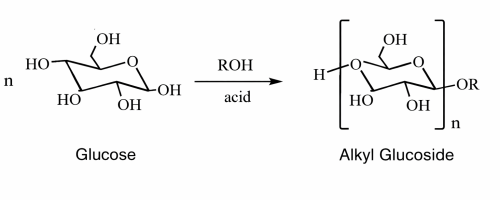
In this industrial process, glucose reacts directly with fatty alcohols under the presence of an acid catalyst. To shift the chemical equilibrium toward the product and maximize yield, water generated during the reaction is continuously removed. This method is the most widely adopted for large-scale production due to its streamlined steps and cost-efficiency.

Figure 1: Chemical Reaction Pathway of Direct Glycosidation

Direct glycosidation process for Alkyl Polyglucoside APG production from glucose and fatty alcohol

How Alkyl Polyglucoside Is Produced: Route 2

2. Transglycosidation

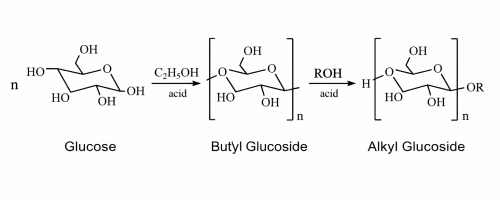
The transglycosidation route involves a two-step synthesis. First, glucose reacts with a short-chain alcohol (such as butanol) to form an intermediate butyl glycoside. This intermediate then undergoes trans-etherification with high-molecular-weight fatty alcohols to produce the final APG surfactant. While the process is more complex, it offers milder reaction conditions and faster overall processing times.

Figure 2: Multi-step Synthesis Mechanism via Transglycosidation

Transglycosidation synthesis mechanism of APG involving short-chain alcohol intermediates

Properties of Alkyl Polyglucoside by Chain Length

The performance of APG surfactant depends largely on its carbon chain length, which determines its HLB value and application suitability:

C8–C10 APG

A candidate for solubility and wetting comparisons under the actual water quality and formulation conditions. Ideal for industrial cleaners and textile auxiliaries in high-electrolyte environments.

C12–C14 APG

A common personal-care screening range; mildness is finished-formula and use-condition specific. Widely used in personal care products like shampoos and facial cleansers to reduce skin irritation.

Main Applications of APG Surfactant

  • Detergents: APG provides excellent soil suspension in dishwashing liquids and laundry detergents. It acts as a performance booster when blended with Alcohol Ethoxylate (AEO-9).
  • Personal Care: APG can be screened for foam and cleansing in shampoos and body washes, while sensitive-skin or baby-care claims require finished-product safety and claim substantiation.

❓ Technical FAQ: Alkyl Polyglucoside (APG)

Q: Can APG be used as a standalone surfactant in heavy-duty cleaners?

A: APG may be used alone or in a blend; compare detergency, foam, viscosity and compatibility at equal active matter. For heavy-duty industrial cleaning, combining APG with AEO-9 or JFC Penetrant provides a broader range of soil removal and faster wetting.

A: Direct Glycosidation is the most common industrial route, offering a balance of high yield and cost-efficiency. Transglycosidation, while more complex, can produce specific high-purity grades required for niche pharmaceutical or high-end cosmetic applications.

🎯 Optimize Your Formula with KEMAIX APG Surfactant

Define the APG grade, performance tests, safety evidence and environmental documentation required for the intended product. KEMAIX Alkyl Polyglucoside (APG) is the professional choice for modern formulators.

Request APG Technical Data & Samples

Quick answer: where APG fits in a surfactant system

Alkyl polyglucosides (APGs) are nonionic surfactants valued for wetting, detergency, electrolyte tolerance and compatibility with anionic, amphoteric and other nonionic surfactants. They are especially useful when a formulation needs a renewable-carbon option or performance across hard water, but grade selection still depends on alkyl-chain distribution, active content, color, viscosity and the complete formulation. APG is not automatically the lowest-foam or lowest-cost choice.

Decision factorTypical APG contributionWhat to verify in the finished formula
Wetting and detergencyStrong surface wetting and useful soil-removal synergyMeasure at use dilution on the actual substrate
Electrolyte and hard-water exposureOften more tolerant than many ionic-only systemsRun salt curve and local-water testing
Foam profileCan produce persistent foam depending on grade and blendTest dynamic foam under process shear
Concentrate viscosityMay raise or destabilize viscosity in high-active blendsMap water, hydrotrope and electrolyte windows
Environmental screeningRenewable feedstock content can be a formulation advantageEvaluate biodegradation, aquatic toxicity and supplier data; do not infer certification from chemistry alone

Evidence boundary: performance varies by APG grade and formulation. “Plant-derived,” “biodegradable” or “mild” claims require product-specific evidence and applicable regulatory review.

Technical review: Grace Dou, surfactant applications team. Reviewed 14 August 2026.

Primary references

Compare APG with alcohol ethoxylates, AEO-9 and JFC penetrant before setting the blend ratio.

Picture of Grace Dou

Grace Dou

Technical Content Reviewer. Grace Dou is a technical content reviewer at Nanjing Kemaix Advanced Materials Co., Ltd., focusing on EO/PO derivatives, nonionic surfactants, formulation scope, test conditions and documentation boundaries. Final grade selection should use current specifications and finished-formula testing.

Scroll to Top