
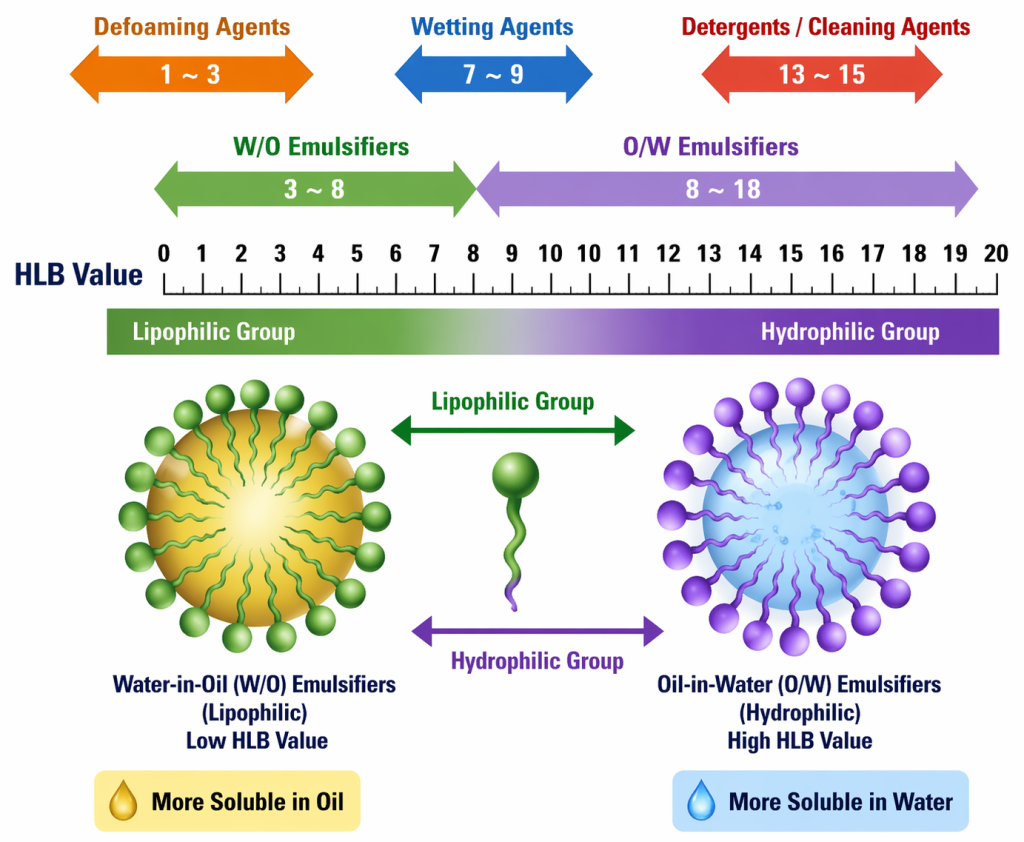
Quick answer: HLB narrows the emulsifier shortlist; it does not prove stability
HLB is an empirical classification scale for surfactants and emulsifiers. Lower relative HLB indicates more lipophilic character, while higher relative HLB indicates more hydrophilic character and generally a stronger tendency toward oil-in-water emulsification. Use HLB to create a small candidate set, then validate the real oil phase, water phase, concentration, temperature, electrolyte, shear and storage conditions.
| Selection stage | How HLB helps | What HLB cannot determine |
|---|---|---|
| Define emulsion direction | Separates more lipophilic from more hydrophilic candidates | Whether a specific grade will stabilize the actual oil |
| Build a blend | Provides a first arithmetic estimate for blend proportion | Synergy, antagonism, impurities or interfacial-film strength |
| Screen concentration | Keeps chemistry direction consistent | Minimum effective dose or cost optimum |
| Set process conditions | Does not replace process design | Droplet size created by shear, addition order or temperature |
| Approve shelf life | Provides no shelf-life proof | Creaming, coalescence, Ostwald ripening or freeze-thaw behavior |
Method boundary: identical calculated HLB values can produce different results because molecular structure and formulation conditions differ. Measure relevant interfacial properties and run finished-emulsion stability tests.
Technical review: Grace Dou, emulsifier applications team. Reviewed 14 August 2026.
Primary references
- IUPAC Gold Book: hydrophile-lipophile balance system
- ISO 6889: determination of interfacial tension
- ISO 1065: cloud point of ethoxylated nonionic surfactants
Apply the calculation with the Span/Tween blend guide, then confirm performance using the controlled comparison framework.
