
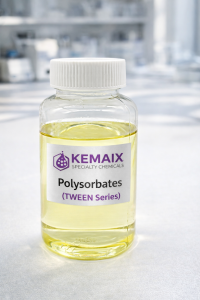
Direct answer: Tween 80 is a hydrophilic nonionic emulsifier whose grade must match the end use
Tween 80 (polysorbate 80; polyoxyethylene (20) sorbitan monooleate) can be screened for O/W emulsification, solubilization, wetting and compatibility support. Industrial suitability depends on oil phase, hydrophobe loading, temperature, salts, shear and storage. Food, pharmaceutical and cosmetic conclusions require the correct grade, specification, impurities, documentation and market authorization.
| Application role | Tween 80 screening contribution | What to verify |
|---|---|---|
| O/W emulsion | Hydrophilic primary or co-emulsifier | Droplet size, creaming, coalescence and temperature cycling |
| Solubilization | Micellar support for limited hydrophobe loading | Clarity, phase boundary and dilution path |
| Span/Tween blend | Hydrophilic component for blend adjustment | Blend ratio and finished-emulsion stability |
| Industrial processing | Nonionic wetting and compatibility candidate | Foam, residue and interaction with other additives |
| Regulated use | Chemistry name alone is insufficient | Compendial/food/cosmetic grade and intended-use documentation |
Evidence boundary: the JECFA specification defines food-additive identity and quality parameters for polysorbate 80; it does not convert an unspecified industrial grade into a compliant regulated-use material.
Technical review: Grace Dou, emulsifier applications team. Reviewed 14 August 2026.
Primary references
- FAO/WHO JECFA: polyoxyethylene (20) sorbitan monooleate
- US FDA Inactive Ingredient Database
- ISO 6889: determination of interfacial tension
Build blends with the Span/Tween guide and compare with the Span 80 industrial guide.
