
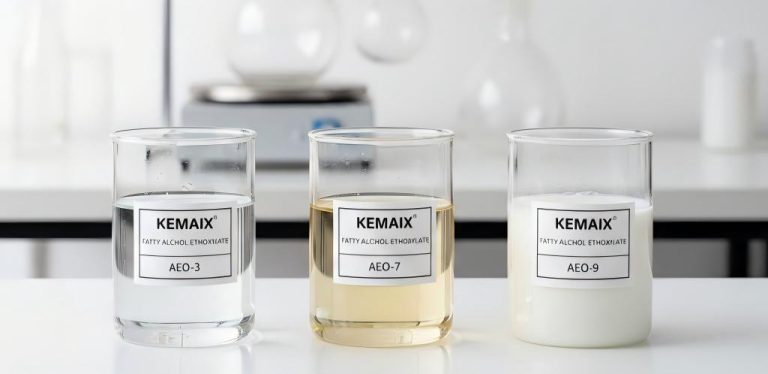

Quick answer: EO number changes the balance of oil affinity, water solubility and temperature behavior
Within a comparable fatty-alcohol feedstock, lower-EO AEO grades are generally more lipophilic, while higher-EO grades are generally more water-compatible. AEO-3 to AEO-9 should therefore be screened by application role, but EO number does not by itself predict foam, detergency, biodegradation, impurities or finished-formula stability.
| Grade direction | Typical screening role | Key confirmation |
|---|---|---|
| AEO-3 / lower EO | Oil-phase affinity, co-emulsification and intermediate feedstock roles | Water dispersibility, blend ratio and interfacial performance |
| AEO-5 to AEO-7 / intermediate EO | Balanced wetting and emulsification candidates | Cloud/phase behavior, foam and electrolyte tolerance |
| AEO-9 / higher EO in this range | Water-compatible detergency, wetting and O/W support | Use-dilution cleaning, rinseability and operating temperature |
| Any AEO grade | Only a formulation starting point | Active matter, homolog distribution, residuals and market documentation |
Evidence boundary: ISO 1065 cloud-point procedures apply to defined ethoxylated nonionic systems and conditions. EPA also notes that chain length, branching and EO/PO number affect aquatic toxicity and biodegradation, so environmental conclusions require grade-specific data.
Technical review: Grace Dou, alcohol-ethoxylate applications team. Reviewed 14 August 2026.
Primary references
- ISO 1065: cloud point of ethoxylated nonionic surfactants
- ISO 8022: determination of wetting power by immersion
- US EPA Safer Choice criteria for surfactants
Use the application-based AEO selection guide and compare grades through the controlled performance framework.
