
Direct answer: Choose the pesticide formulation type and stabilization mechanism before selecting the emulsifier package; EC, EW, SC, SE and ME require different screening.
Choosing the Right Emulsifier for EC, EW, SC, SE & ME Pesticide Formulations
An emulsifier that gives a crystal-clear 40% cypermethrin EC can separate in a lambda-cyhalothrin EW — or foam out a suspension concentrate. This guide matches surfactant chemistry to formulation type, HLB and active.
Request a Formulation Consultation
Every emulsifier choice comes back to the balance between the hydrophilic head and lipophilic tail — quantified as HLB.
Match the Emulsifier to the Formulation Type
Choosing an emulsifier is not a single decision — it changes completely with the formulation type, the active ingredient, and the solvent system.
Each system imposes different demands: an EC needs a nonionic + anionic pair that emulsifies spontaneously in water; an EW must hold a pre-formed oil phase stable for two years; an SC needs dispersants and wetting agents, not classic emulsifiers. The tool that ties them together is the Hydrophile–Lipophile Balance (HLB).
Formulation-to-Emulsifier Selection Matrix
| Formulation | Typical Actives | Recommended Kemaix Chemistry | Target HLB |
|---|---|---|---|
| EC — Emulsifiable Concentrate | Cypermethrin, Chlorpyrifos, Glyphosate, Butachlor | Castor Oil Ethoxylate (EL-40 / EL-60) + anionic Ca-DDBS | 12 – 15 |
| EW — Emulsion in Water | Lambda-cyhalothrin, Cypermethrin, Butachlor | EL-40 / EL-60 + Tween 80 | 12 – 14 |
| SC — Suspension Concentrate | Imidacloprid, Azoxystrobin, Carbendazim | Low-foam Block Polyether (L61/L62) + wetting agent | Dispersant-led |
| SE — Suspo-Emulsion | Atrazine + oil-active combinations | EL series + Span/Tween blend | 11 – 14 |
| ME — Microemulsion | Cypermethrin, Abamectin, Glyphosate | High-HLB EL-60 / Tween 80 + co-surfactant | 14 – 16 |
Active-ingredient and loading windows reflect standard EC (40–50%), EW (2.5–10%), SC (20–50%) and ME (2.5–10%) practice.
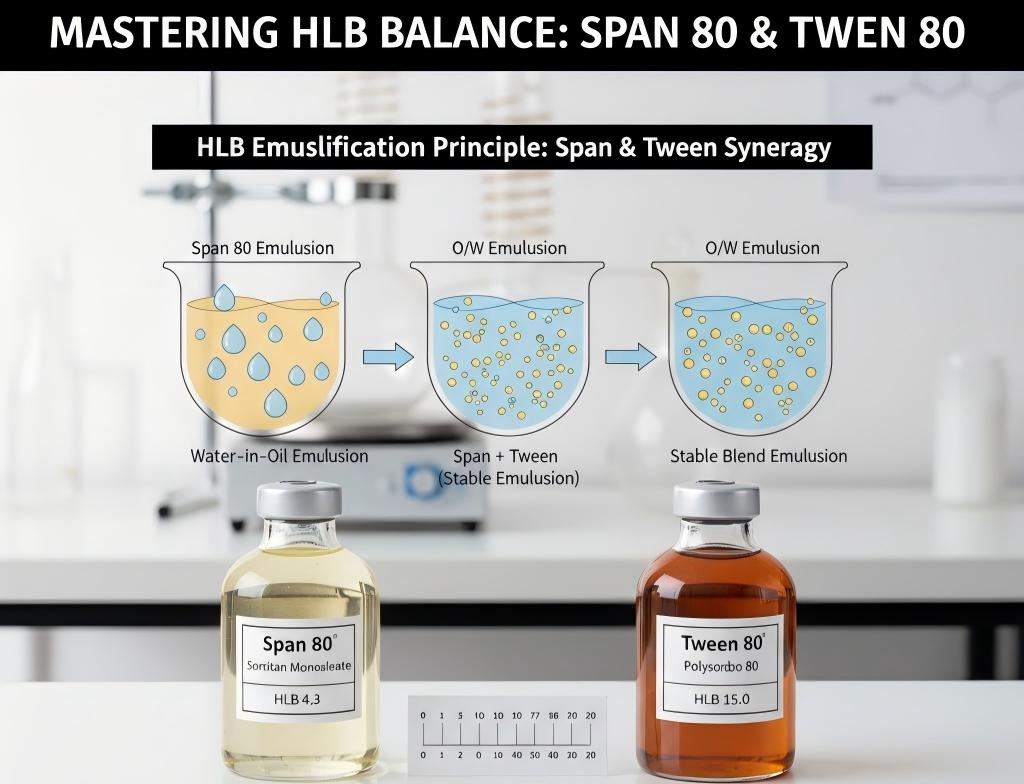
Most agrochemical emulsifiers are blends — pairing a low-HLB anchor with a high-HLB partner to hit the required HLB.
How to Calculate the Blend
A single surfactant rarely hits the required HLB (RHLB) of the oil phase, so you pair a lipophilic (low-HLB) surfactant with a hydrophilic (high-HLB) one:
% EL-60 = (13 − 4.3) ÷ (15 − 4.3) = ~81% → Span 80 ~19%
In real EC systems this nonionic blend is further paired with an anionic calcium dodecylbenzene sulfonate for fast, spontaneous emulsification. Kemaix supplies the nonionic castor-oil-ethoxylate side of that pair.
| Grade | HLB | Role in the Blend |
|---|---|---|
| Span 80 | 4.3 | Lipophilic anchor (W/O side) |
| EL-40 | 13 – 14 | Workhorse EC / EW nonionic emulsifier |
| EL-60 | 14 – 15.5 | High-HLB O/W emulsifier for EW / ME |
| Tween 80 | 15 | Hydrophilic co-emulsifier |
| Block Polyether L61 / L62 | 3 / 7 | Low-foam dispersant for SC / WP |
Emulsifier Selection by Formulation Type

The classic EC emulsifier is an anionic + nonionic system. Use EL-40 or EL-60 as the nonionic component with calcium dodecylbenzene sulfonate, targeting a blend HLB of 12–15 by solvent aromaticity. For 40–50% cypermethrin or chlorpyrifos loads, grade on emulsion clarity plus hard-water dilution stability (CIPAC method) at 0.25% and 5%.
Because the emulsion is pre-formed, droplet-size control is everything. A EL-40 / Tween 80 high-HLB pair (HLB 12–14) stabilises low-load actives such as lambda-cyhalothrin (2.5–10%). EW is the low-VOC, water-based route — favour it for liquid or low-melting actives.
SC is a dispersion and wetting problem, not an emulsification one. Reach for low-foam block polyethers (L61/L62) and wetting agents for anti-settling and re-suspendability of actives like imidacloprid or azoxystrobin (20–50%). See our Pesticide SC Formulation Guide for dispersant loading.
SE carries a suspended solid and an emulsified liquid active in one system — you need both a dispersant and an emulsifier that will not destabilise each other. A balanced EL + Span/Tween blend at HLB 11–14 is the starting point for atrazine combinations (40–50%).
ME requires a high total surfactant load plus a co-surfactant to reach the ultra-low interfacial tension of a transparent, thermodynamically stable system. Use high-HLB EL-60 or Tween 80 (HLB 14–16) for abamectin or cypermethrin (2.5–10%).
Common Failure Points
⚠ Cold-storage separation (0 °C)
Nonionic emulsifiers lose hydration as temperature drops. If EW/ME fails at 0 °C, shift the blend higher in HLB or add a co-surfactant.
⚠ Hard-water instability
EC emulsions are graded in 342 ppm hard water. Tune anionic Ca-DDBS tolerance and the nonionic EL ratio together; test at 0.25% and 5% dilution.
⚠ Batch-to-batch HLB drift
A ±0.5 HLB variance between lots can flip a passing formula into failure. Insist on traceable saponification value and moisture on every COA.
⚠ Foam in SC / WP
Using an emulsifier where a low-foam dispersant belongs is the most common SC mistake. Switch to block-polyether chemistry.
Frequently Asked Questions
Which emulsifier is best for a 40% cypermethrin EC?
A nonionic castor-oil-ethoxylate such as EL-40 (HLB 13–14) blended with anionic calcium dodecylbenzene sulfonate, tuned to a system HLB near 13. Validate with clarity and hard-water dilution tests before scale-up.
What HLB range do most EC and EW pesticide formulations need?
Most aromatic-solvent EC and liquid-active EW systems fall in the HLB 12–15 window. The exact target depends on the required HLB of your solvent and active — start at 13 and bracket ±1.
Can I use the same emulsifier for EC and SC?
No. EC needs a spontaneous emulsifier system; SC needs dispersants and low-foam wetting agents. An EC emulsifier in an SC typically causes foaming and poor suspension stability.
Why does my emulsion separate after cold storage but pass at room temperature?
Nonionic surfactants become less hydrophilic as temperature falls, lowering effective HLB. Increase the high-HLB fraction (more EL-60 or Tween 80) or add a co-surfactant, then re-run the 0 °C test.
Are Kemaix agrochemical emulsifiers suitable for eco-friendly formulations?
Yes. The EL castor-oil-ethoxylate series and EW/ME systems support low-VOC, water-based routes, and the nonionic surfactants are APEO-free.
Get a Formulation-Matched Emulsifier Recommendation
Tell us your formulation type, active ingredient, solvent and target loading — our technical team returns the exact Kemaix grade and blend ratio, with TDS/COA and free samples for your stability trials.
Request Samples & TDS
Grace Dou is a technical content reviewer at Nanjing Kemaix Advanced Materials Co., Ltd., focusing on EO/PO derivatives, nonionic surfactants, formulation scope, test conditions and documentation boundaries. Final grade selection should use current specifications and finished-formula testing.
Related Kemaix Resources
External References
- HLB — Hydrophilic-Lipophilic Balance
- Nonionic Surfactants (overview)
- CIPAC — Methods & Publications
- FAO/WHO Pesticide Specifications
 Kemaix Specialty Chemicals · Nonionic Surfactants & EO/PO Derivatives · sales@kemaix.com
Quick answer: choose the formulation system before choosing the emulsifier
EC, EW, SC, SE and ME do not share one universal emulsifier package. Start with the continuous phase and dispersed phase, then screen surfactant chemistry against the active ingredient, solvent or oil phase, water hardness, dilution ratio and storage temperature. An EC must form a stable emulsion after dilution; an EW must stabilize oil droplets in water; an SC needs wetting and dispersion of solid particles; an SE must control both suspended solids and emulsified droplets; and an ME must maintain a thermodynamically stable, transparent or translucent domain.
| Formulation | Primary interface to control | First screening priority | Minimum confirmation |
|---|---|---|---|
| EC | Oil concentrate diluted into water | Solvent compatibility and emulsification after dilution | Emulsion characteristics across intended water qualities |
| EW | Oil droplets dispersed in water | Droplet stabilization and low-temperature robustness | Particle-size trend, creaming and storage cycling |
| SC | Solid active dispersed in water | Wetting, dispersant adsorption and rheology balance | Sedimentation, redispersibility and dilution behavior |
| SE | Solid particles plus oil droplets in water | Compatibility between dispersant and emulsifier packages | Both particle and droplet stability after aging |
| ME | Oil, water and surfactant/co-surfactant domain | Phase region and temperature tolerance | Clarity, phase boundary and dilution path |
Evidence boundary: this matrix is a formulation-screening framework, not a pesticide registration claim or a substitute for product-specific stability, efficacy, toxicology and local regulatory testing.
Frequently asked formulation questions
Can one emulsifier package be used for EC, EW, SC, SE and ME?
No. The phases and stabilization mechanisms differ, so each formulation type needs its own compatibility and performance screening.
What should be checked before scale-up?
Confirm active-ingredient and solvent compatibility, water hardness, dilution ratio, temperature range, storage cycling and the relevant CIPAC test methods before scale-up.
Does a passing laboratory emulsion prove field or registration performance?
No. Laboratory emulsion behavior is only one screening result and does not replace efficacy, safety, storage, packaging and regulatory studies.
Technical review: Grace Dou, formulation applications team. Reviewed 14 August 2026.
Primary references
Related Kemaix guidance: pesticide formulation guide and SC surfactant selection.