
NP-10 Replacement: Strategic Transition to APEO-Free Surfactants

For decades, Nonylphenol Ethoxylate (NP-10) has been the global benchmark for industrial emulsification and wetting due to its balanced HLB and low cost. However, under increasing regulatory pressure from EU REACH and US EPA, manufacturers are fast-tracking the shift toward sustainable chemistry.

Finding an effective NP-10 replacement surfactant is no longer just about environmental compliance; it is an opportunity to improve formulation performance through modern, biodegradable alternatives.

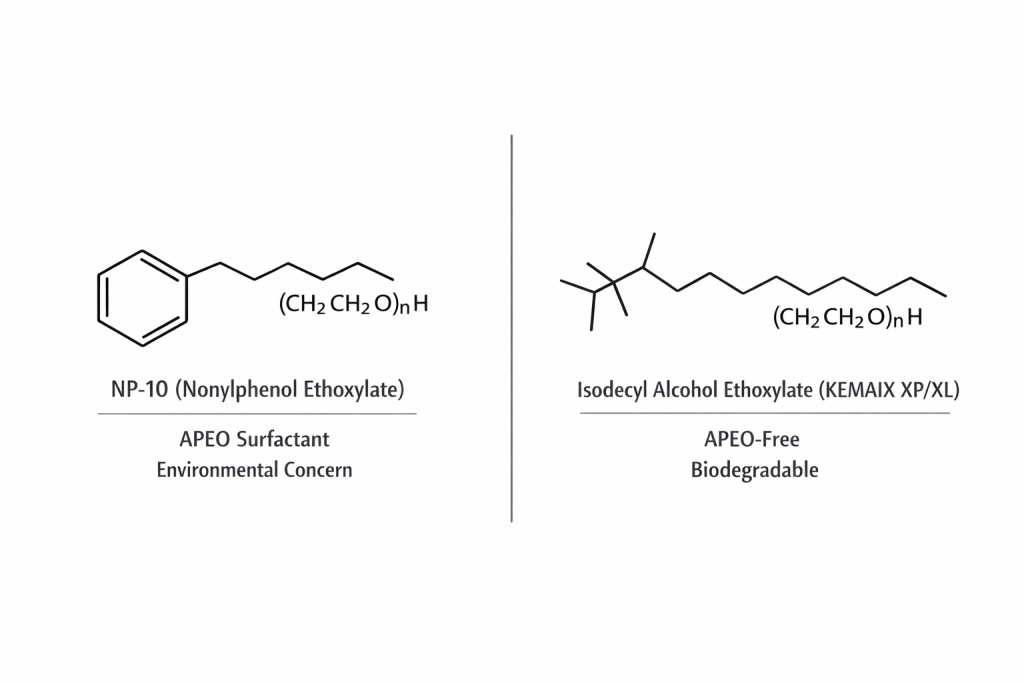
A visual comparison of NP-10 Replacement Surfactant (APEO) vs biodegradable Isomeric Alcohol Ethoxylate structure

1. The NP-10 Performance Baseline

To define a replacement screening target, first analyse the physical constants of Nonylphenol Ethoxylate (NP-10) that established it as an industry benchmark for emulsification and wetting.

Parameter NP-10 Standard Value
HLB Value 13.3 (Excellent Oil-in-Water Emulsification)
Cloud Point (1% aq.) 62°C – 65°C
Surface Tension (0.1% aq.) ~30 dynes/cm
Regulatory Status Restricted in many regions (APEO-related issues)

2. KEMAIX Solutions: Advanced Isomeric Alcohol Ethoxylates

The most effective NP-10 replacement surfactant currently available is the Isomeric Alcohol Ethoxylate (XP/XL Series). Unlike linear surfactants, the branched structure of isomeric alcohols provides several technical advantages:

  • Faster Wetting: XP-series surfactants often reduce wetting time by 30-50% compared to NP-10.

  • Low Pour Point: They remain liquid at lower temperatures, simplifying winter storage and handling.

  • Biodegradability: Review exact-substance biodegradability data and the requirements for the intended market, use and finished product.

3. Technical Comparison: NP-10 vs. KEMAIX APEO-Free Series

Feature NP-10 (Traditional) KEMAIX XP-Series
HLB Value 13.3 13.0 – 13.5 (Adjustable)
Wetting Power Standard Compare by a defined wetting method
Eco-Compliance Restricted (APEO) REACH Compliant
Handling Gels in cold water Excellent cold solubility

💡 Field Note: Managing the Switch

Switching from NP-10 to an NP-10 replacement surfactant isn’t always a 1:1 swap in the formula. Because isomeric alcohols have different dynamic surface tensions, you might find that you actually need less surfactant to achieve the same wetting result. We always recommend performing a cloud point check of the final blended formula to ensure stability hasn’t shifted.

❓ FAQ: NP-10 Replacement Challenges

Q1: Will an APEO-Free replacement affect the shelf life of my emulsion?

A: Generally, no. Our NP-10 replacement surfactant options are chemically stable and often provide better resistance to oxidation. However, since the packing of molecules at the oil-water interface differs, we suggest a 30-day accelerated stability test.

A: Yes, KEMAIX XP and XL series are fully compatible with existing Nonylphenol Ethoxylates. This allows for a gradual phase-out strategy to manage inventory costs.

A: For processes exceeding 60°C, we recommend our Isomeric XP-90 or XL-90, which offer a higher cloud point and maintain emulsification power under thermal stress.

📦 Storage and Handling of NP-10 Replacement Surfactant

Technical Handling: NP-10 Replacement Surfactant

Maintaining the purity of NP-10 replacement surfactant is essential for high-precision industrial applications. Unlike traditional APEOs, our isomeric series has a much lower pour point, significantly reducing the risk of solidification in outdoor storage tanks.

  • Vessel Choice: Stainless steel or high-density polyethylene (HDPE) containers are recommended.
  • Moisture Control: Always keep the container tightly sealed. As high-purity surfactants, these products are hygroscopic and can absorb atmospheric moisture if left exposed.
  • Shelf Life: When stored between 5°C and 35°C in original packaging, the NP-10 replacement surfactant requires the current grade-specific TDS, label and order documentation to establish storage range and shelf life.

🎯 Conclusion: Transitioning to Sustainable Performance

Regulatory and buyer requirements differ by market, substance, use and finished product. After selecting a candidate NP-10 replacement surfactant, screen wetting and stability, then verify the exact APEO restrictions and documentation required for the destination market.

Unsure which APEO-Free alternative matches your HLB requirements?

KEMAIX provides comprehensive technical cross-referencing. Send us your current NP-10 or OP-10 application parameters, and the laboratory can propose candidate grades for finished-formula validation.

* Request current, grade-specific regulatory and environmental documents for the intended market and use; REACH, RoHS and biodegradability are separate scopes.

Quick answer: replace NP-10 by function and compliance scope, not by HLB alone

An APEO-free NP-10 replacement is normally a formulation project rather than a one-for-one ingredient swap. Match the original wetting, emulsification, detergency, foam, cloud point and electrolyte tolerance at equal active matter, then confirm the exact market and end-use restrictions. Linear or branched alcohol ethoxylates and other nonionic blends can be starting candidates, but no grade is a universal NP-10 equivalent.

Replacement stepQuestion to answerEvidence to retain
Define the functionIs NP-10 primarily wetting, emulsifying, detergency or coupling?Current formula, use level and controlled benchmark data
Screen candidatesWhich structure reproduces performance at equal active matter?Wetting, foam, cloud/phase behavior and stability results
Check applicationWill the replacement contact textiles, coatings, cleaners or another regulated article?Market-specific restriction and customer specification review
Verify supplyDoes “APEO-free” have a defined analytical or supplier limit?Specification, SDS, declaration and agreed test method
Revalidate the productDid substitution change preservation, packaging or field performance?Finished-product aging and application data

Regulatory boundary: Regulation (EU) 2016/26 added REACH Annex XVII entry 46a for NPE in textile articles expected to be washed in water, with a 0.01% by-weight threshold and stated exceptions. This is not evidence of one identical worldwide restriction for every NP-10 use; review the current rule, destination market and application.

Technical review: Grace Dou, nonionic surfactant applications team. Reviewed 14 August 2026.

Primary references

Start candidate screening with the isomeric alcohol ethoxylate guide and compare test variables in the performance framework.

Picture of Grace Dou

Grace Dou

Grace Dou is a technical content reviewer at Nanjing Kemaix Advanced Materials Co., Ltd., focusing on EO/PO derivatives, nonionic surfactants, formulation scope, test conditions and documentation boundaries. Final grade selection should use current specifications and finished-formula testing.

Scroll to Top