
Alkyl Polyglucoside (APG): High-Performance Green Surfactants for Harsh Environments
Introduction: The Rise of Green Surfactants
In the modern chemical industry, formulators are under increasing pressure to balance high performance with environmental sustainability. Alkyl Polyglucoside (APG) has emerged as a premier nonionic surfactant that meets these demands. Synthesized from renewable glucose and fatty alcohols, APG is widely recognized for its excellent biodegradability, low toxicity, and superior mildness, making it a “green” cornerstone for both consumer and industrial formulations.
What Is Alkyl Polyglucoside (APG)?
Alkyl polyglucoside belongs to the sugar-based surfactant family. It is produced through the reaction of glucose with fatty alcohols, typically within the C8–C16 carbon chain range. Usually supplied as a light yellow liquid or white paste, APG offers a unique set of technical advantages:
Nonionic Nature: Compatible with anionic, cationic, and other nonionic surfactants.
Exceptional Stability: Maintains performance in high-electrolyte and strong alkaline systems.
Low Irritation: Extremely mild on skin and eyes, ideal for sensitive applications.
Technical Properties Based on Carbon Chain Length
How Alkyl Polyglucoside Is Produced: Route 1
1. Direct Glycosidation
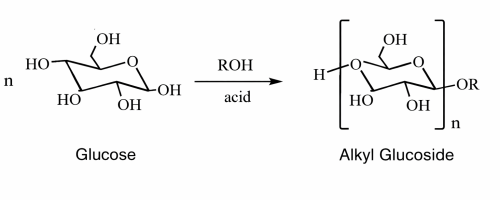
In this industrial process, glucose reacts directly with fatty alcohols under the presence of an acid catalyst. To shift the chemical equilibrium toward the product and maximize yield, water generated during the reaction is continuously removed. This method is the most widely adopted for large-scale production due to its streamlined steps and cost-efficiency.
Figure 1: Chemical Reaction Pathway of Direct Glycosidation
How Alkyl Polyglucoside Is Produced: Route 2
2. Transglycosidation
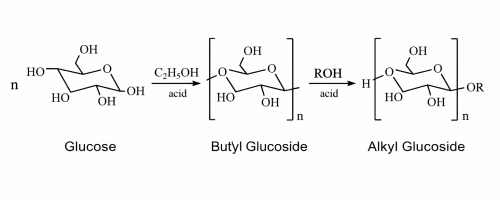
The transglycosidation route involves a two-step synthesis. First, glucose reacts with a short-chain alcohol (such as butanol) to form an intermediate butyl glycoside. This intermediate then undergoes trans-etherification with high-molecular-weight fatty alcohols to produce the final APG surfactant. While the process is more complex, it offers milder reaction conditions and faster overall processing times.
Figure 2: Multi-step Synthesis Mechanism via Transglycosidation
Properties of Alkyl Polyglucoside by Chain Length
The performance of APG surfactant depends largely on its carbon chain length, which determines its HLB value and application suitability:
C8–C10 APG
Excellent solubility and wetting power. Ideal for industrial cleaners and textile auxiliaries in high-electrolyte environments.
C12–C14 APG
The standard for mildness. Widely used in personal care products like shampoos and facial cleansers to reduce skin irritation.
Main Applications of APG Surfactant
- ✔ Detergents: APG provides excellent soil suspension in dishwashing liquids and laundry detergents. It acts as a performance booster when blended with Alcohol Ethoxylate (AEO-9).
- ✔ Personal Care: APG creates soft foam and reduces irritation in shampoos and body washes, making it a staple for sensitive skin and baby care products.
❓ Technical FAQ: Alkyl Polyglucoside (APG)
Q: Can APG be used as a standalone surfactant in heavy-duty cleaners?
A: While APG has strong detergency, it is most effective when used in a synergistic blend. For heavy-duty industrial cleaning, combining APG with AEO-9 or JFC Penetrant provides a broader range of soil removal and faster wetting.
Q: How does the production method affect the final APG quality?
A: Direct Glycosidation is the most common industrial route, offering a balance of high yield and cost-efficiency. Transglycosidation, while more complex, can produce specific high-purity grades required for niche pharmaceutical or high-end cosmetic applications.
🎯 Optimize Your Formula with KEMAIX APG Surfactant
Ready to enhance your product with a surfactant that balances performance, mildness, and sustainability? KEMAIX Alkyl Polyglucoside (APG) is the professional choice for modern formulators.
Request APG Technical Data & Samples