
End-capped Alcohol Ethoxylates: Solving Gel and Foam Issues in AEO Formulations

In the demanding world of industrial spray cleaning and concentrated detergent manufacturing, traditional surfactants often hit a physical bottleneck. While standard Fatty Alcohol Ethoxylates (like AEO-9) offer excellent detergency, they are notorious for two operational headaches: excessive foaming under high-pressure agitation and the formation of a stubborn, unmanageable “Gel Zone” during water dilution. These issues lead to clogged dispensing systems, increased production downtime, and inconsistent final products. To address these challenges, KEMAIX introduces advanced End-capping Technology—a molecular modification that fundamentally transforms the performance profile of standard ethoxylates.

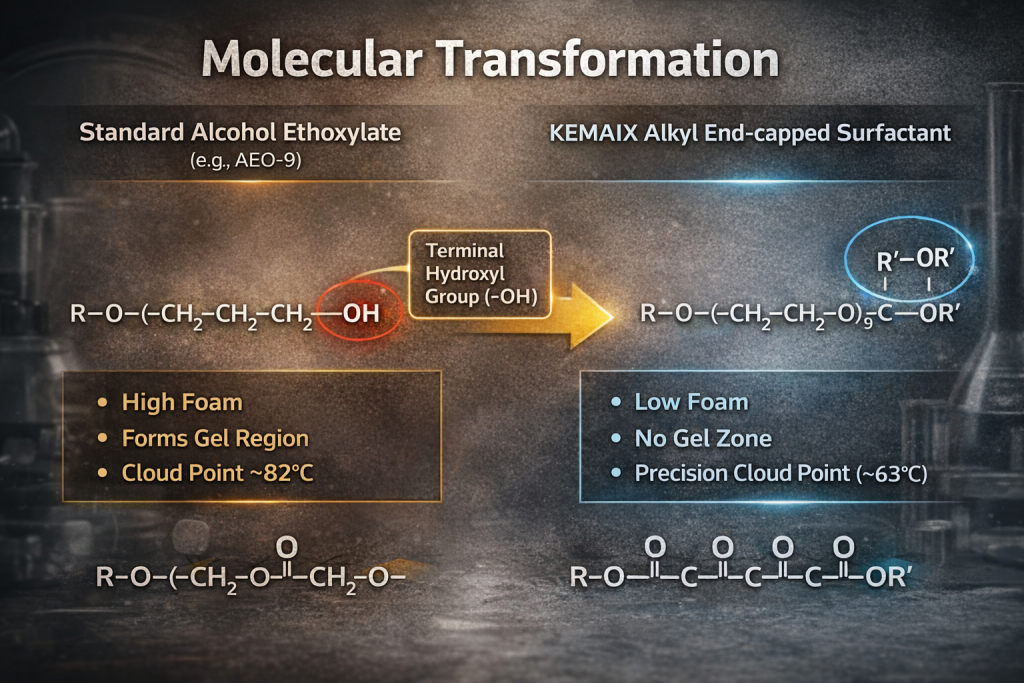
Chemical structure comparison of standard AEO and **End-capped Alcohol Ethoxylates** demonstrating how alkyl capping eliminates gel zones and reduces foam.

End-capped Alcohol Ethoxylates: Solving Gel and Foam Issues in AEO Formulations

What are End-capped Alcohol Ethoxylates?

End-capped Alcohol Ethoxylates are specialized non-ionic surfactants where the terminal Hydroxyl group (-OH) is replaced by an Alkoxy group (-OR). This chemical modification, known as End-capping Technology, creates a “low-foam, non-gel” version of the traditional AEO series, specifically engineered for high-efficiency industrial processes.

Technical Breakthroughs: Why Switch to End-capped Technology?

1. Eliminating the “Gel Zone” for Easier Handling

Standard AEO-9 forms a rubber-like, high-viscosity gel at specific water concentrations. KEMAIX End-capped Alcohol Ethoxylates completely eliminate this gel area, ensuring the product remains a flowable liquid at all dilution ratios, preventing pipe blockages and pump strain.

2. Precision Cloud Point for 60°C Industrial Cleaning

Maximum oil-removal activity occurs near the surfactant’s cloud point. By lowering the cloud point of AEO-9 from 82°C to approximately 63°C via end-capping, we align the chemical activity perfectly with the standard 60°C operating temperature of industrial spray lines.

3. Superior Emulsification with Lower Foaming

Alkyl end-capping significantly extends emulsification stability. In paraffin oil tests, separation time increases from 222s to 330s. Simultaneously, the foam volume is drastically reduced, allowing for high-pressure agitation without overflow.

Comparative Performance: Standard vs. End-capped AEO

Performance Metric Standard AEO-9 End-capped AEO9-C
Gel Area (During Dilution) Forms Thick Gel Zero Gel Zone
Emulsification Time (Paraffin) 222 Seconds 330 Seconds
Cloud Point (1% aq.) ~ 82°C ~ 63°C
Wetting Time (Standard) 9.3 Seconds 8.8 Seconds

❓ Technical FAQ: Optimizing Your Formulation

Q: Does the lower alkali resistance of end-capped surfactants affect heavy-duty degreasers?

A: While alkali resistance drops from approximately 60g/L to 40g/L NaOH (compared to standard AEO), this range is still more than sufficient for the vast majority of industrial spray and immersion cleaners. Unless your formulation requires extreme caustic levels (above 4%), KEMAIX End-capped AEO9-C remains exceptionally stable and effective.

A: Yes, they are highly recommended for specific applications. They are especially effective in “low-foam” front-loading laundry liquids or automatic dishwasher detergents where foam control and fast dissolution are critical selling points. They also help prevent the product from thickening or gelling in the detergent drawer.

A: Cleaning efficiency, especially degreasing, reaches its peak when the operating temperature is near the surfactant’s cloud point. By lowering the cloud point from 82°C to 63°C, the surfactant becomes more active at the common industrial cleaning temperature (60°C), leading to faster oil-water separation and better surface cleaning.

🎯 Upgrade Your Formula with KEMAIX Technology

Don’t let gel-phases and excessive foam limit your production efficiency. Switching to KEMAIX Alkyl End-capped Alcohol Ethoxylates allows for cleaner processing, easier handling, and a high-performance end product that delivers consistent results to your customers.

Picture of Grace Dou

Grace Dou

Specialist in EO/PO Derivatives & Surface Chemistry. With 10+ years of experience in chemical export and formulation optimization at Kemaix, Grace provides technical insights to help global clients achieve superior emulsification stability.

Need Free Samples for Testing?

Get professional technical support and free samples for your chemical formulations.

Get Samples Now
Scroll to Top