
Industrial Emulsion Selection Guide
How to Select Surfactants for Wax and Silicone Emulsions
Wax and silicone may both be dispersed in water, but they require separate surfactant screening plans.
Use this framework to compare Span, Tween and other nonionic candidates through controlled tests, not as a universal recipe.
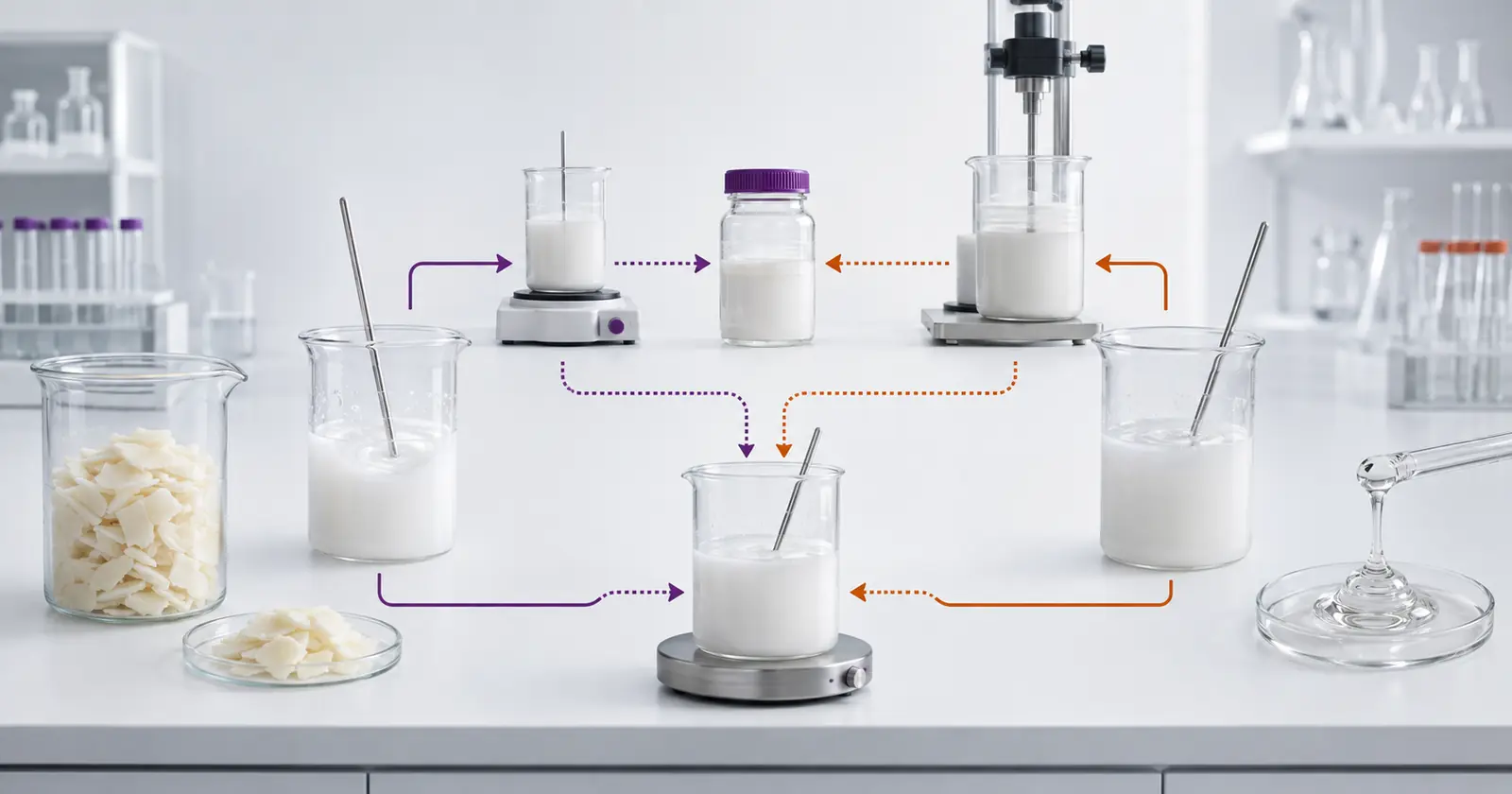
Start with the phase
First Decide Which Emulsion Problem You Actually Have
A milky, water-continuous appearance does not show that two emulsions have the same interfacial problem. Start with the dispersed phase and intended emulsion type.
Wax screening lane
Identify the Exact Wax
Record whether the phase is paraffin, microcrystalline or another wax grade. Add available composition information and melting range.
Define target solids and whether the project requires an oil-in-water or water-in-oil structure. Use HLB to rank nonionic candidates, then test the exact wax and process.
Silicone screening lane
Identify the Silicone Chemistry
Record whether the phase is PDMS or a modified silicone, along with functionality and viscosity grade.
Define the required continuous phase and whether the silicone is a raw fluid, functional fluid or existing emulsion. Screen silicone-compatible chemistry, surfactant package and mixing conditions. Do not assume a wax blend transfers.
A study of one paraffin-wax system found that HLB, surfactant concentration, temperature and emulsification route affected the resulting emulsion. Its numerical findings apply to the reported wax, Span 80/Tween 80 package and emulsion inversion point procedure. They are not a universal target for other waxes. See the Colloids and Surfaces A study on paraffin-wax emulsions.
Under controlled emulsification conditions, one study found droplet-size distributions varied across the tested PDMS viscosity grades. The authors inferred that higher-molar-mass PDMS may require different energy, time or surfactant levels. See the PDMS emulsion design study. A Wacker exact-product page identifies a product as a nonionic oil-in-water emulsion of high-viscosity PDMS and requires users to determine optimum conditions through their own tests.
Appearance and dilution behavior do not establish storage stability, temperature tolerance or end-use performance. Keep the wax and silicone screens separate until both reach the validation gates.
Candidate screening
Use HLB to Build a Shortlist, Not to Declare a Winner
HLB helps rank nonionic surfactants by relative hydrophilic and lipophilic character. It can narrow a wax-emulsion screen and define calculated blend points, but it does not identify a finished formula.
Kemaix lists the values below as typical family screening data. They are not batch-release limits, exact-grade acceptance criteria or performance guarantees.
Swipe horizontally to review all columns.
| Kemaix family | Grade and typical HLB | Candidate role | What still requires testing |
|---|---|---|---|
| Span Sorbitan fatty-acid esters |
Span 20: 8.6 Span 40: 6.7 Span 60: 4.7 Span 80: 4.3 Span 85: 1.8 |
Lower-HLB, more oil-affine partners for building a nonionic blend | Exact wax compatibility, emulsion type, formation, separation and end-use response |
| Tween Polyoxyethylene sorbitan fatty-acid esters |
Tween 20: 16.5 Tween 40: 15.5 Tween 60: 14.5 Tween 80: 15.0 |
Higher-HLB, more water-affine partners for building a nonionic blend | Exact phase behavior, process response, dilution and storage testing |
| AEO family | Grade-dependent. No exact-grade value or recommendation is stated here. | Optional family-level nonionic co-emulsifier screening path | Current exact-grade evidence and tests in the buyer’s wax or silicone system |
For a two-surfactant blend, calculate the blend HLB from each component’s typical HLB and mass fraction. This gives a defined series of candidate blend points. It does not establish the required HLB of an unidentified oil phase or a batch-release property of either surfactant.
In one paraffin-wax study, changing HLB, surfactant concentration, temperature and route changed the tested emulsion. The reported optimum belongs to that wax, Span 80/Tween 80 package and procedure. Do not transfer it to a different paraffin grade, microcrystalline wax or silicone fluid.
For silicone, use HLB as one descriptor rather than proof of compatibility. Silicone identity, functionality, viscosity, phase ratio, surfactant chemistry and emulsification conditions can change the result. An HLB calculation cannot guarantee droplet-size distribution, viscosity, freeze-thaw response, shelf stability or end-use performance.
Build a small candidate bracket, hold the process constant, and apply the same acceptance criteria to every sample.
Control the comparison
Define the Process Window Before You Compare Emulsifiers
Compare emulsifiers only after defining the dispersed phase, formulation and process. If one variable changes, record it and treat the batch as a separate test condition.
- Exact dispersed phase: commercial wax name and grade, silicone type, functionality, supplier data and available composition information.
- Physical property: wax melting range or silicone viscosity at a stated condition.
- Phase design: oil-to-water ratio, target solids and intended oil-in-water or water-in-oil form.
- Surfactant basis: candidate identities, blend ratio, total level and calculation basis.
- Addition sequence: which phase receives each surfactant, charging order and timing of water addition.
- Temperature profile: temperatures during melting, mixing, addition and cooling, with relevant hold times.
- Mixing: equipment type, batch size, geometry, speed, shear time and vessel dimensions.
- Water phase: water source, hardness or conductivity, pH, electrolytes, thickeners and co-solvents.
- Use conditions: dilution water, dilution ratio, application temperature, substrate and expected storage or transport exposure.
The cited silicone studies illustrate different controls. In the PDMS textile study, PDMS viscosity grade and amount were associated with different droplet-size distributions under the stated emulsification process. In a separate ionic system, CTAB and selected salts affected interfacial adsorption, zeta potential and coalescence behavior. See the PDMS emulsion design study and the silicone oil, ionic surfactant and electrolyte study. These are system-specific findings, not Kemaix product claims.
Phase inversion, hot-melt addition or a phase-inversion-temperature approach may be evaluated for selected materials. None is a universal instruction. Define one baseline, vary one planned factor at a time, and document each batch so the comparison can be repeated.
Risk control
Validate in Three Gates Before Scale-Up
Approve a surfactant package only against acceptance criteria defined for your product. These three gates organize evidence without imposing universal pass limits.
-
Gate 1: Bench Formation
Prepare each candidate with the same materials, phase ratio, batch size, addition order, temperature profile and mixing input. Record whether the intended emulsion forms and how it changes during cooling. Measure appearance and viscosity by your chosen methods. If particle-size measurement is available, record the instrument, sample preparation and distribution result instead of making a visual size estimate.
-
Gate 2: Storage and Use-Condition Stress
Observe creaming, sedimentation, separation, viscosity change and visible coalescence over project-defined intervals. Test the actual temperature cycle, dilution water, pH and electrolyte exposure. Evaluate compatibility after adding the remaining formulation ingredients. Record end-use performance against buyer-defined criteria, such as coating behavior, release, textile hand or polish response. A uniform fresh sample does not establish shelf life.
-
Gate 3: Pilot Scale
Transfer the selected candidate to representative equipment. Compare heating and cooling rates, addition time, circulation, shear zone, batch turnover and hold time with the bench process. Sample from defined locations and repeat the same analytical and application checks. Investigate any shift before production approval.
The cited paraffin study shows that route and temperature affected its defined wax system. The PDMS study found different droplet-size distributions across its tested viscosity grades and PDMS amounts. The ionic silicone-oil study found that CTAB and selected electrolytes affected interfacial charge and coalescence. These results justify controlled validation, not preset operating conditions.
Kemaix supplies surfactant candidates and reviews current TDS, SDS or MSDS and batch COA availability by exact grade and order. Kemaix does not approve or guarantee the finished-emulsion formula. Production acceptance remains project-specific and depends on the customer’s validation.
Technical FAQ
Questions to Resolve Before Requesting a Sample
Is HLB alone enough to choose a wax emulsion surfactant?
No. HLB can rank candidates and define a repeatable blend series. The exact wax, phase ratio, surfactant level, temperature profile and mixing route still require controlled tests.
Can the same emulsifier serve wax and silicone systems?
It may enter both screening lists, but suitability in one system does not establish suitability in the other. Screen wax and silicone separately with the exact dispersed phase and intended process.
Does Kemaix supply a finished wax or silicone emulsion?
This article covers Kemaix Span and Tween candidates plus an optional family-level AEO screening path. It does not promise a finished emulsion or formula. Confirm the requested supply scope during exact-grade review.
What data does Kemaix need?
Send the phase name and supplier grade, available technical data, wax melting range or silicone viscosity, target solids, intended emulsion type, water-phase composition, process equipment, temperature profile, use conditions and pass criteria.
Are samples and documents available?
Standard products can be supplied from 200 kg, subject to exact-grade and order confirmation. A free 200 to 500 g sample may be available with the corresponding COA. Kemaix checks TDS, SDS or MSDS and batch COA availability for the exact product and order.
Send This Technical Brief
Include:
- exact wax or silicone identity and supplier grade;
- melting range or viscosity with its test condition;
- oil-to-water ratio, target solids and intended emulsion type;
- proposed surfactant basis and candidates already tested;
- equipment, batch size, addition order, temperature and mixing conditions;
- water quality, pH, electrolytes, co-solvents and other ingredients;
- storage, dilution, application and end-use conditions;
- measurable acceptance criteria, required quantity and document list.
What Kemaix Reviews Next
Kemaix will review candidate and exact-grade availability, current documentation and practical sample options. If an AEO or customized option is discussed, exact-grade evidence and project feasibility must be confirmed before it is presented as a candidate.
Kemaix does not provide finished-formula approval. The customer’s tests determine final approval.
